Que la fête commence!
The French Influence on the Good Life in New Orleans
An Exhibit from the New Orleans Public Library
This exhibit offers a variety of primary and secondary sources from the Archives documenting the Good Life in New Orleans, with an emphasis on the food and entertainment culture. The diverse sources include court records, period images, advertisements, and other items from our Special Collections.
This exhibit is divided into four sections; use the buttons below to jump to any section. Once you finish a section you can choose scroll onto the next one, or return to the top of the page to navigate to a different section.
Good Food
Good Time
-
Restaurants
Some of the restaurants that have made an impact on New Orleans.
-
Bars and Alcohol
Bars and a variety of alcohols have also been known to contribute to the Good Life in New Orleans.
-
Opera
Opera has been part of the culture of New Orleans since 1796.
-
Other Entertainment
Balls, theatre, and Carnival season also add entertainment variety to the city.
Good Food
Restaurants
Antoine’s Restaurant
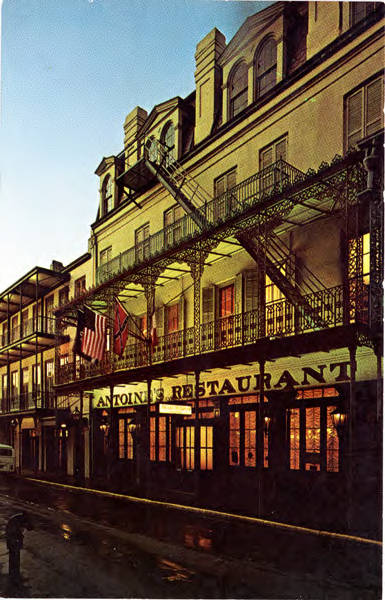
Antoine’s is probably the world’s most famous restaurant…. Many of the marvelous dishes on the menu were invented or brought over from France in the 1830s by founder Antoine Alciatore. He began his career at the age of twelve, working in the kitchen of the Hotel de Noailles in Marseilles….Arriving in the French city of New Orleans at the mouth of the Mississippi, he worked briefly at the St. Charles Hotel. In 1840 he opened a pension on St. Louis Street. In the dining room downstairs he served his guests not only Pommes Soufflees, but his own creations, Boeuf Robespierre and Dinde Talleyrand.
Deirdre Stanforth, The New Orleans Restaurant Cookbook (1967), p. 22-23.
Antoine's Restaurant exterior
Postcard collection
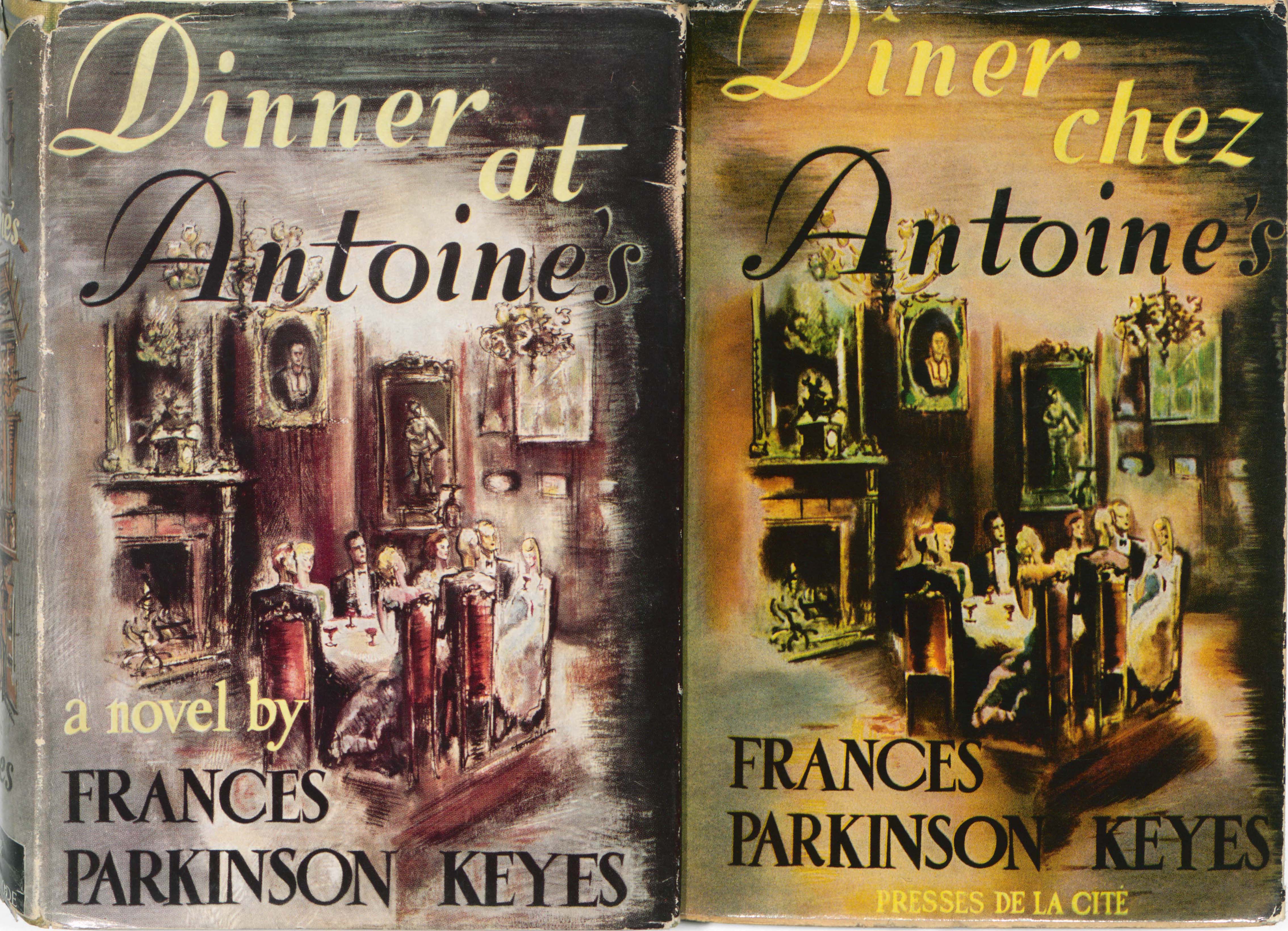
Dinner at Antoine's book cover
The French edition of Dinner at Antoine’s, probably the best known novel by Frances Parkinson Keyes, was published in Paris fifty years ago. New Orleans Public Library has an extensive collection of texts of Mrs. Keyes’ works in multiple languages. Diner Chez Antoine’s is available in Danish, Dutch, Finnish, German, Italian, Norwegian, Portuguese, Spanish, and Swedish, in addition to the English and French editions.
Rare Book Collection
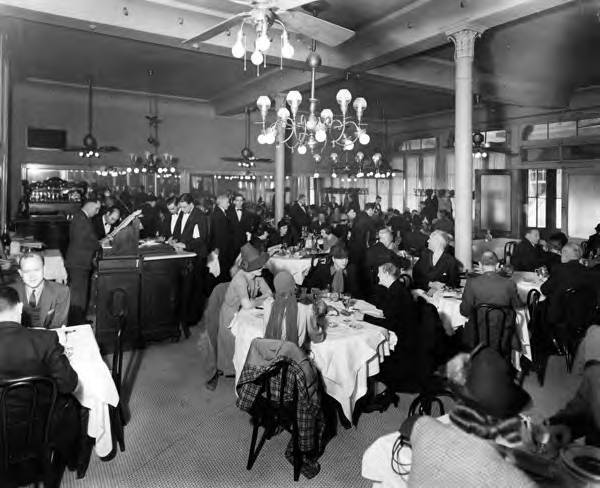
Antoine's Restaurant interior
The main dining room at Antoine’s as it appeared in 1951. Even at that late date the gas chandeliers provided the only heat for the room during the winter months!
Louisiana Photograph Collection
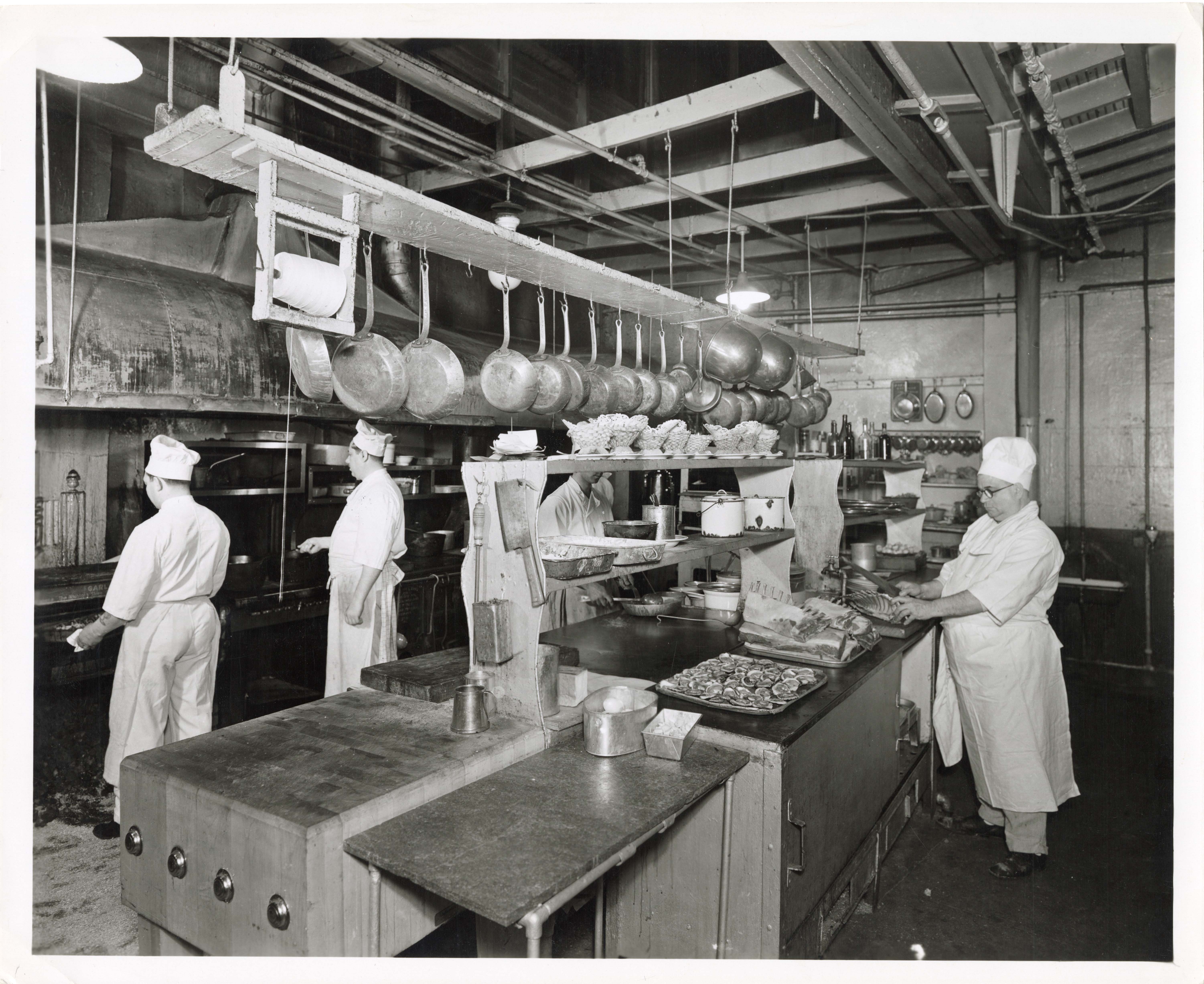
Antoine's Restaurant Kitchen interior
The kitchen at Antoine’s as it appeared in 1951. The restaurant’s chefs were still using ancient coalburning stoves to prepare meals for their many patrons. Note the oyster shells ready and waiting to be transformed into Oysters Rockefeller and the row of little baskets, soon to be filled with the delectable souffléed potatoes.
Photograph by R. E. Covey. Louisiana Photograph Collection
Thank God the French got here first.Can you imagine what New Orleans might have been had the Pilgrims gotten off at Pilottown instead of Plymouth?It’s frightening . . . we might have been burning witches instead of cafe brulot; or preaching to the quadroon beauties, instead of dancing with them; or spending eons eating boiled beef and potatoes, instead of ecrevisse Cardinal, or pompano en papillote, or gumbo.
Only in the food of New Orleans is the Gallic influence unmistakable. Food is a major topic of conversation in New Orleans as in France, and the newcomer is overwhelmed with advice on what and where to eat.
Sarah Searight, New Orleans (1973), p. 56.
Restaurants are kept by Frenchmen and in the French style. Dishes are a mixture of French and Creole cooking, which is much appreciated by “bon vivants.”
James S. Zacharie, New Orleans Guide (1893), p. 27.
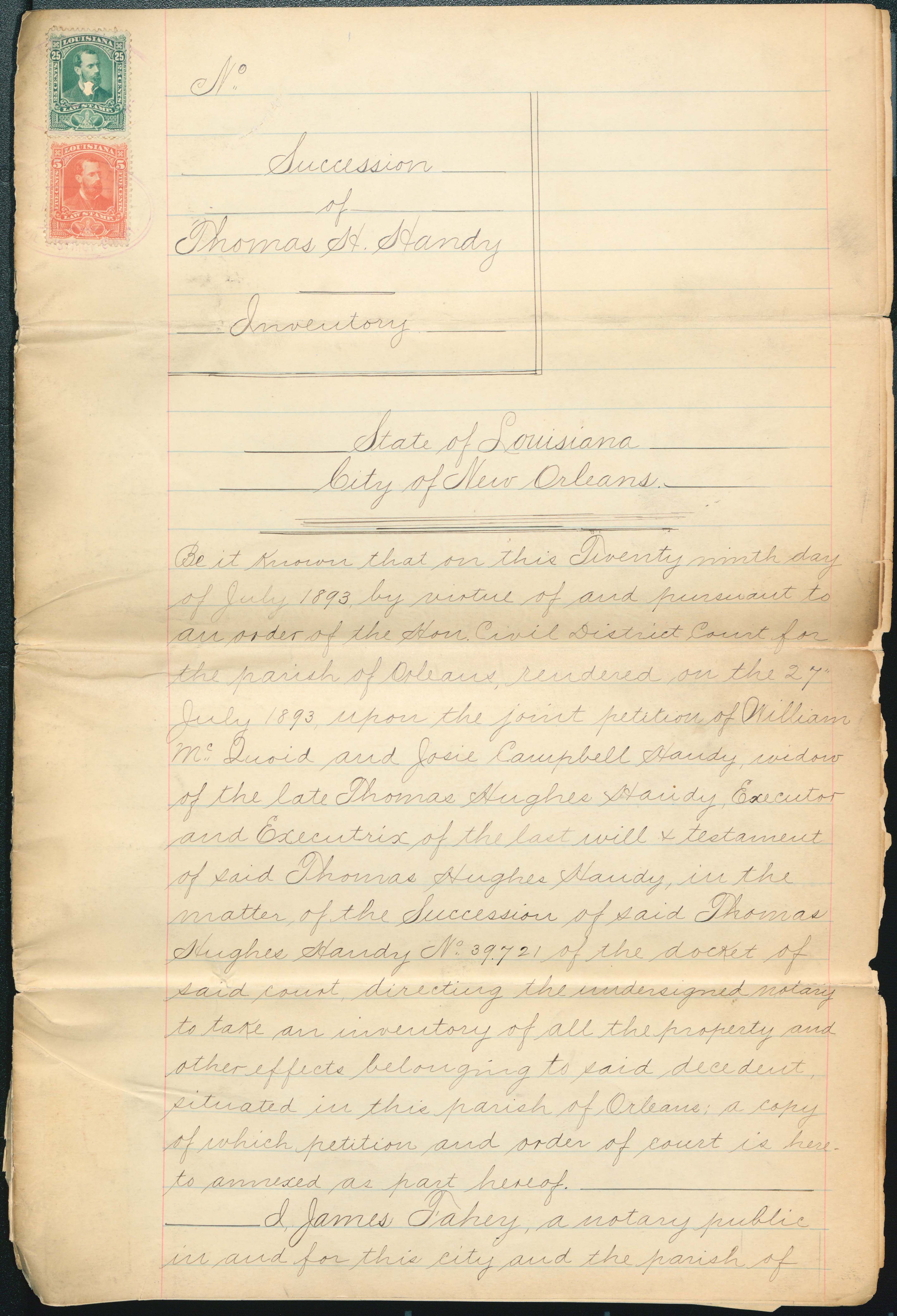
This detailed twelve-page inventory summarizes the estate that Angelo, alias Antoine, Alciatore left following his 1877 death in Marseille. The succession indicates that the Alciatore restaurant adjoined a twenty-two room lodging house; those chambers now house the myriad of individual dining rooms that form the present-day Antoine’s. Alciatore’s death certificate, also filed among the papers, shows that he was born in Alassio, a town on the Italian coast, not too far from the French city of Marseille.
Civil District Court #30896. Click the images above to view the inventory. Contact City Archives & Special Collections to view the rest of the case.
Arnaud’s Restaurant
…Arnaud’s was started by the ebullient “Count” Arnaud in 1920. Arnaud was born Leon Bertrand Arnaud Cazenave in the French village of Bosdaros, on the outskirts of the city of Pau, residence of the Kings of Navarre…. After completing his education in Paris at the Lycee Napoleon, Cazenave decided to come to America, where he hoped to study medicine… However, he soon realized that he would not be able to afford the years of college necessary for becoming a doctor, so he put to use his knowledge of the vineyards of France as a salesman of wines and champagnes. In his travels he discovered that New Orleans, which reminded him of his native land, was the place he wanted to settle down and live.
Deirdre Stanforth, The New Orleans Restaurant Cookbook (1967), p. 31.
Bon-Ton Café
This 1889 advertisement documents a little-known, and probably short-lived, establishment on Magazine Street operated by members of the same family that founded Commander’s Palace in 1880. According to the 1888 city directory, Anthony Commander worked at least for a while as a bartender at the Sazerac Saloon. Interestingly, the Bon-Ton advertised here was only a few doors down Magazine Street from the original location of the present-day Bon Ton Cafe.
Business Guide of New Orleans and Vicinity (Baltimore, 1889).
French Market
[The Vieux Carre’s] straight but narrow streets intersected at right angles and read like a roll call of Gallic nobility and Catholic sainthood–Chartres, Burgundy, Royale, Conte, Conde, St. Pierre, Ste. Ann. There could be no doubt that this was a French town. In the center of the plot, opening to the river, the Place d’Armes, or city square, fronted on the imposing mass of the cathedral, flanked by the Cabildo (city hall) on one side and the Presbytere (courthouse) on the other. The whole life of the city more or less converged here. Hard by, abutting the central quadrangle along the levee to the front, the old market swarmed with bedizened slaves out for the day’s purchasing, haggling with the equally black overseers of stalls loaded with meat, fish, fowl and vegetables of the neighborhood. Ranged along either side of the square, cramped and murky dry-goods stores shared the view of the parade grounds with even more numerous grog shops and tippling places, for then even more than now the city bulged with centers of cheer.
Joseph G. Tregle, Jr., Louisiana in the Age of Jackson (1999), p. 13.
Hotel and Restaurant de la Louisiane
The Hotel and Restaurant de la Louisiane was founded by Louis Bezaudun in 1881 at 107 & 109 Customhouse Street (now 725 Iberville) in a building constructed in 1837 as the residence of James Waters Zacharie. Later the restaurant was managed by Bezaudun’s nephew, Fernand Alciatore (brother of Jules Alciatore of Antoine’s) and by succeeding generations of Alciatores. Famed not only for its cuisine but for its decor (the magnificent leaded glass doors and Baccarat chandelier), in its heyday, La Louisiane entertained such luminaries as Sarah Bernhardt, Al Jolson, Theodore Roosevelt, Harry Houdini, William Jennings Bryan and Rube Goldberg. An early guest, George Washington Cable, wrote in the restaurant’s guest book, “La Louisiane is one of the most beguiling and satisfying spots in all my native city.”
Business Guide of New Orleans and Vicinity (Baltimore, 1889).
Lebrun’s Restaurant
Lucien Lebrun operated bars and restaurants at various locations around the Vieux Carre during the 1880s. This advertisement from 1889 encourages New Orleanians to, for lack of a better translation, “pig out.” Two doors down from the Lebrun establishment was the building left to the city in 1845 by Abijah Fisk. That bequest was the beginning of the New Orleans Public Library. The F. W. Woolworth company purchased the property (now 728 Iberville St.) in 1944 and built a new structure.
Business Guide of New Orleans and Vicinity (Baltimore, 1889).
Madame Begue’s
Creole cookery was devised by no man in no age, but evolved over the years out of the richness of the natural larder that is southern Louisiana. It has borrowed from other types, but is essentially itself, with perhaps a more marked tendency toward the French cuisine from which it took its early form.
Recipes and Reminiscences of New Orleans (1971), p. 5.
Flour and Bakeries
Because wheat could not readily be grown in the vicinity of New Orleans, there was always a shortage of white flour in the early days of the city’s history. The only source of supply was France, whose vessels, loaded with food stuffs for the little colony, would arrive in port every two or three months…. The precious flour, never in sufficient quantities, would be stored in the city’s warehouses, to be doled out when and to whom the government officials pleased. So the daily bread of the early citizens of New Orleans often was Indian corn meal cake, a poor substitute for the crisp, fragrant loaves of their native France…. As the years went on, French tastes predominated and pain francais became the city’s undisputed Creole favorite.
Recipes and Reminiscences of New Orleans (1971), p. 133.
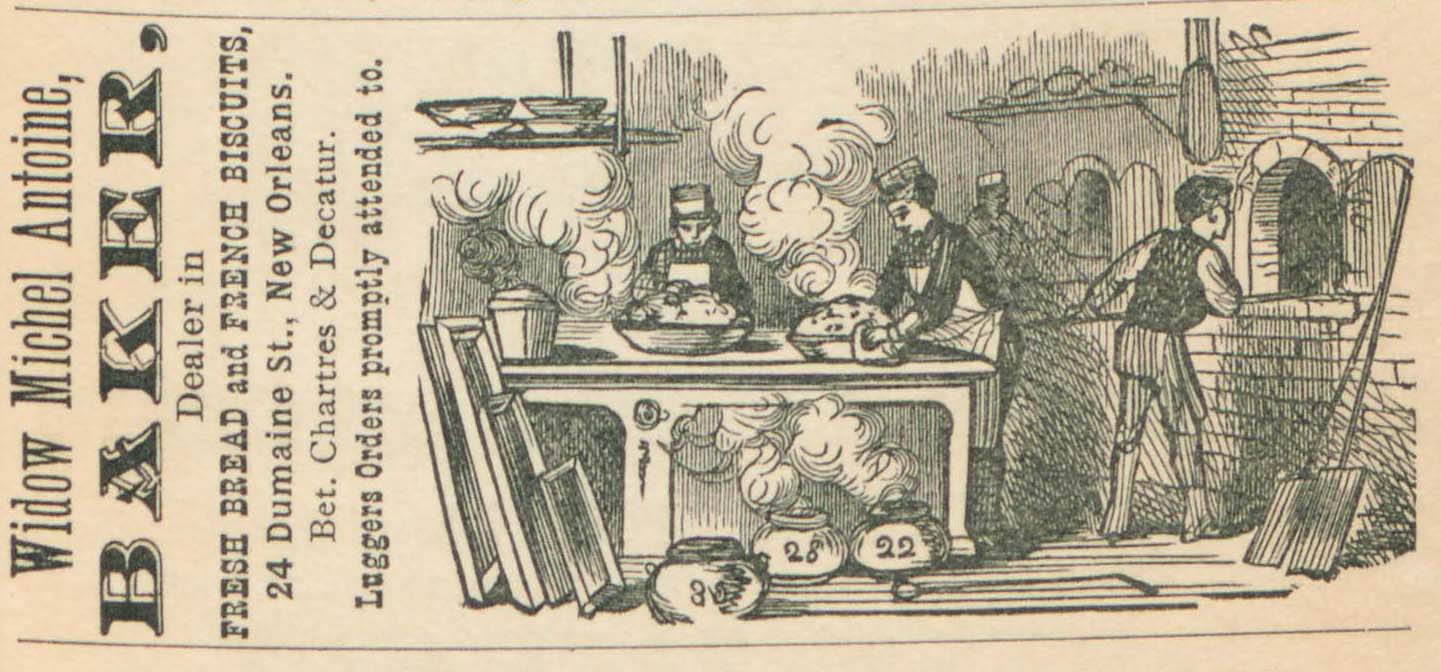
Widow Michel Antoine, Baker
Michel Antoine, a native of France, operated the bakery at 24 Dumaine Street until his death in 1887. His wife carried on the family business at the same location after his passing.
Business Guide of New Orleans and Vicinity (Baltimore, 1889).
Jacques Moulon, Baker
This page records three transactions involving the supply of flour to the residents of New Orleans. The middle item documents the delivery of biscuits and bread to a ship in port by a local baker, Jacques Moulon.
Miscellaneous French and Spanish Documents of New Orleans, Document 3.
Bars and Alcohol
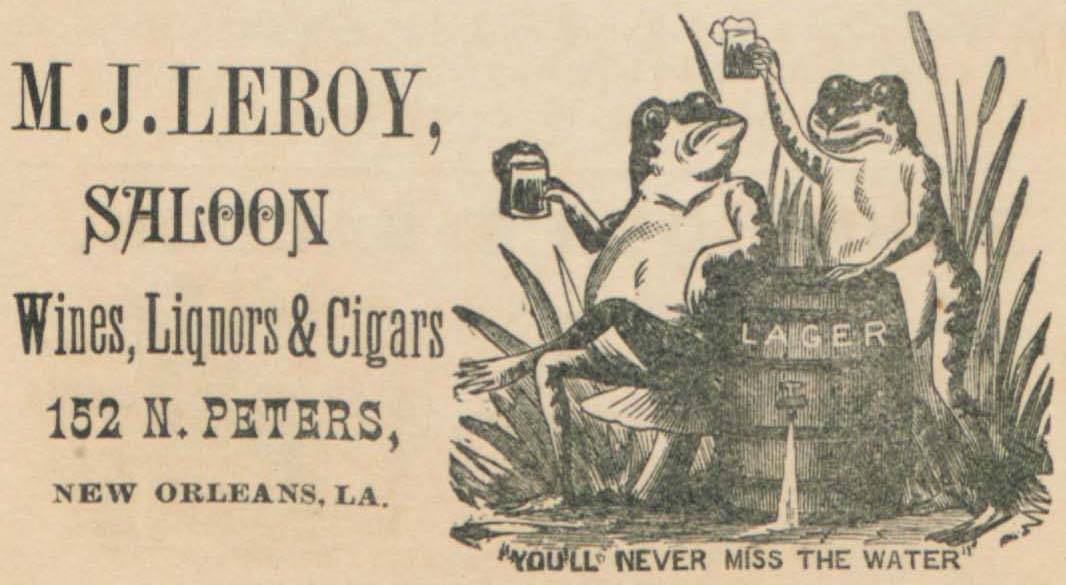
Hypolite Begue's Saloon
This advertisement for Hypolite Begue's saloon appeared in the 1903 Souvenir Program for the International Association of Chiefs of Police convention in the Crescent City.
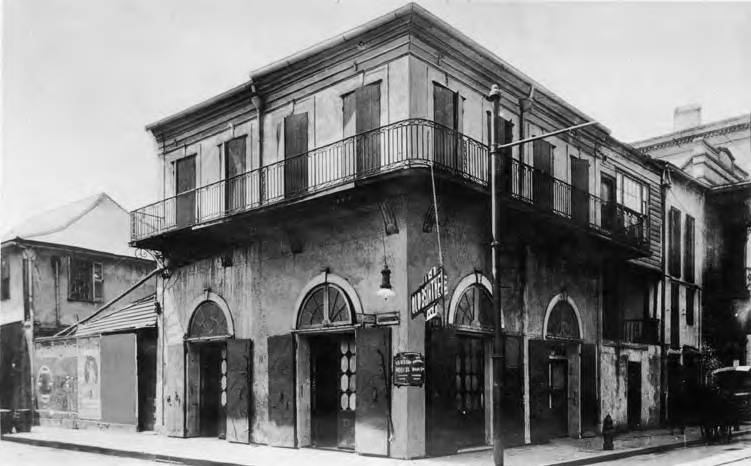
Old Absinthe House
The Old Absinthe House, 240 Bourbon Street, ca. 1890s.
Louisiana Photograph Collection
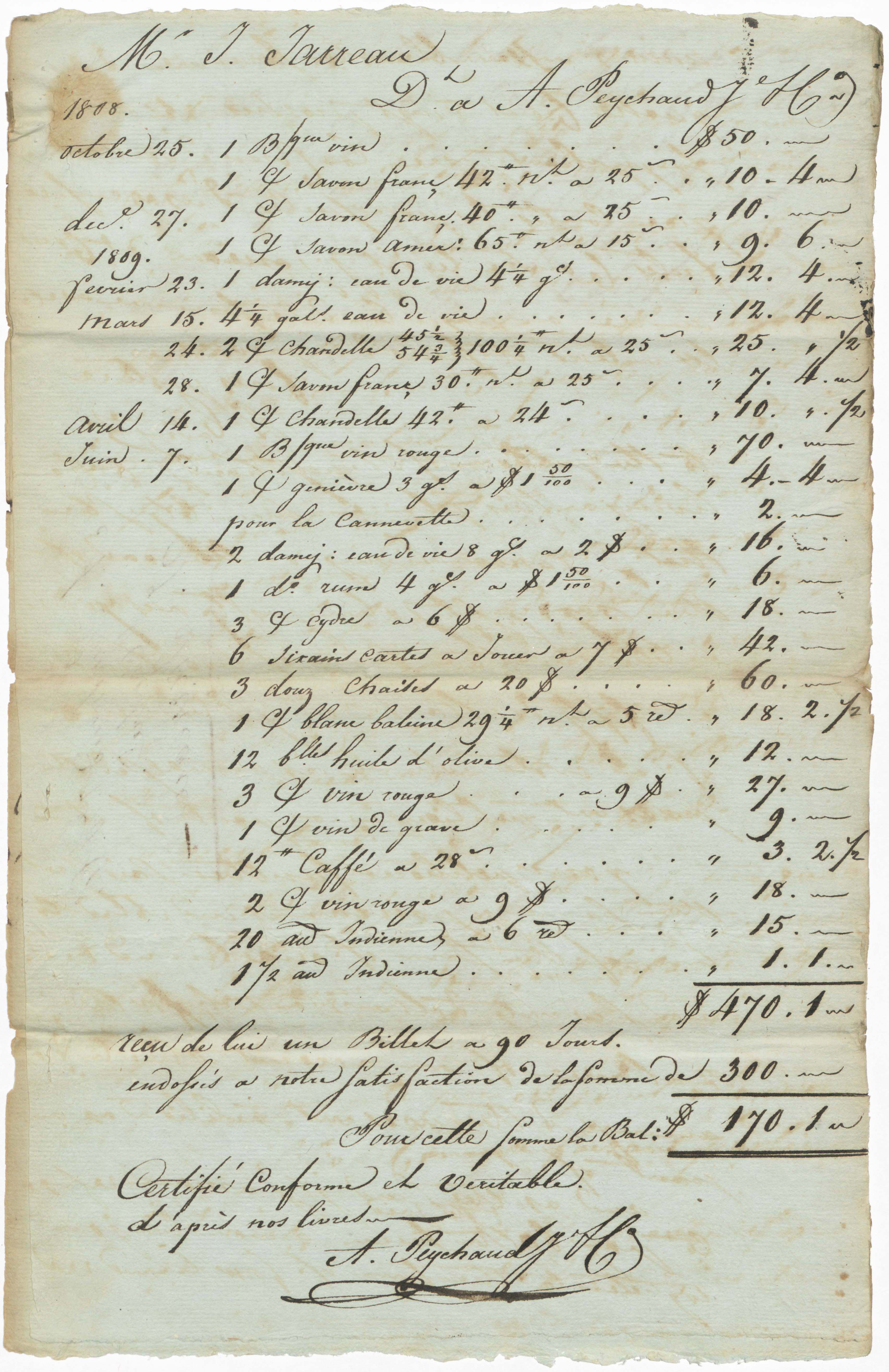
Jean Jarreau
Account of goods sold by A. Peychaud & Co. to Jean Jarreau in 1808 and 1809. Jarreau probably used the wines and liquors--and the playing cards--at his coffeehouse on the left bank of Bayou St. John. We originally thought that A. Peychaud was Antoine Amedee Peychaud (better known as the pharmacist who created the bitters that still bear his name), but additional evidence suggests that he was actually Paul Mathias Anatole Peychaud. Anatole was a New Orleans merchant and officeholder who once ran unsuccessfully for mayor.
Sazerac Saloon
Thomas H. Handy's 1893 succession papers include this inventory of the Sazerac Saloon. Most of the ingredients of the famous cocktail--rye whiskey, absinthe, and Angostura Bitters--appear on these pages. Other pages in the document enumerate additional barrels of unbranded bitters, possibly Peychaud's. It is also interesting to note that although rye already had replaced brandy as the drink's main ingredient, a good supply of Sazerac brandy remained in stock at the eponymous bar room.
Civil District Court #29721
Click on the documents above to view them in their entirety. The rest of the Handy case may be viewed by contacting City Archives & Special Collections.
Speaking of Sazerac Saloon
For years one of the favorite brands of cognac imported into New Orleans was a brand manufactured by the firm of Sazerac-de-Forge et fils, of Limoges, France. The local agent for this firm was John B. Schiller. In 1859 Schiller opened a liquid dispensary at 18 Exchange Alley, naming it “Sazerac Coffehouse” after the brand of cognac served exclusively at his bar.Schiller’s brandy cocktails became the drink of the day and his business flourished, surviving even the War Between the States. In 1870 Thomas H. Handy, his bookkeeper, succeeded as proprietor and changed the name to “Sazerac House.” An alteration in the mixture also took place. Peychaud’s bitters was still used to add the right fillip, but American rye whiskey was substituted for the cognac to please the tastes of Americans who preferred “red likker” to any pale-faced brandy.Thus brandy vanished from the Sazerac cocktail to be replaced by whiskey … and the dash of absinthe was added. … The absinthe innovation has been credited to Leon Lamothe who in 1858 was a bartender for Emile Seignouret, Charles Cavorac & Co., a wine importing firm located in the old Seignouret mansion still standing at 520 Royal street. More likely it was about 1870, when Lamothe was employed at Pina’s restaurant in Burgundy street that he experimented with absinthe and made the Sazerac what it is today.
Good Time
Opera
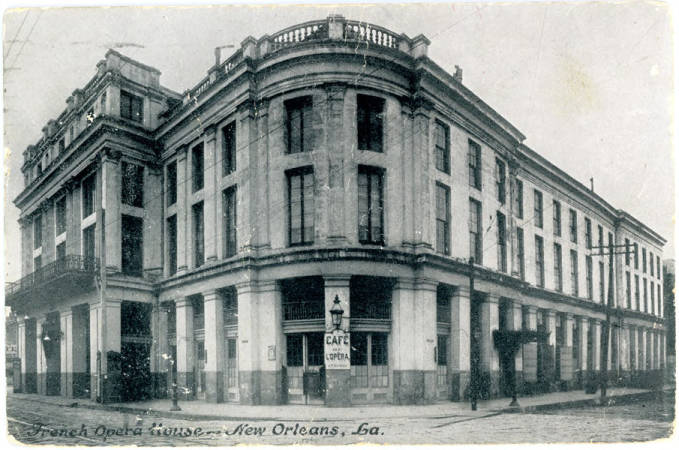
French Opera House
The French Opera House itself was the most fashionable establishment in New Orleans in the years between the Civil War and World War I. Simply to attend the opera there was a social event of importance, replete with ritual and tradition.
French Opera House exterior
Postcard Collection
French Opera House exterior
Postcard Collection
French Opera House exterior
Postcard Collection
The first night of the opera season is the opening of the social season in New Orleans, and the opera itself is the most important feature of New Orleans social life. For nearly a century it has held the undisputed first place in the hearts of the people of the delightful old French-American city, and it grows each year in popularity and in pride of place. It must be understood, however, that New Orleans loves her French opera not because of the social side of the operatic season, but because she has been taught for generations to love it for the music and for art’s sake. . . . The music and musicians are the first consideration in this splendid old house; consequently New Orleans knows her great composers, her Mozart, Meyerbeer, Rossini, Verdi, in great detail, and knowing them so is able to listen and enjoy the understandingly. Another thing which adds to New Orleans’s enjoyment of French opera, and has doubtless had much to do with the great popularity of the institution, is the fact that one-fourth of the population of the city speaks French in ordinary daily intercourse, while another two-fourths is able to understand the language perfectly.
Gone, all gone. The curtain has fallen for the last time upon “Les Huguenots,” long a favorite of the New Orleans public. The opera house has gone in a blaze of horror and of glory. There is a pall over the city; eyes are filled with tears and hearts are heavy. Old memories, tucked away in the dusty cobwebs of forgotten years, have come out like ghosts to dance in the last, ghastly Walpurgis ballet of flame.The heart of the old French quarter has stopped beating.
Of course, my folks never had the idea they wanted a musician in the family. They always had it in their minds that a musician was a tramp, trying to duck work, with the exception of the French opera house players which they patronized. As a matter of fact, I, myself, was inspired to play piano by going to a recital at the French opera house.
Alan Lomax, Mr. Jelly Roll (New York, 1950), p. 6.
Opera was New Orleans’ cultural glory throughout the nineteenth century. This city had its own self-supporting, resident company which, for much of the century, offered the best opera to be found in America. Its superiority was especially marked before the Civil War when the presentation of opera in other American cities was sporadic and transient.
Henry A. Kmen. Music in New Orleans: The Formative Years, 1791-1841. Louisiana State University Press, 1966, p. 56.
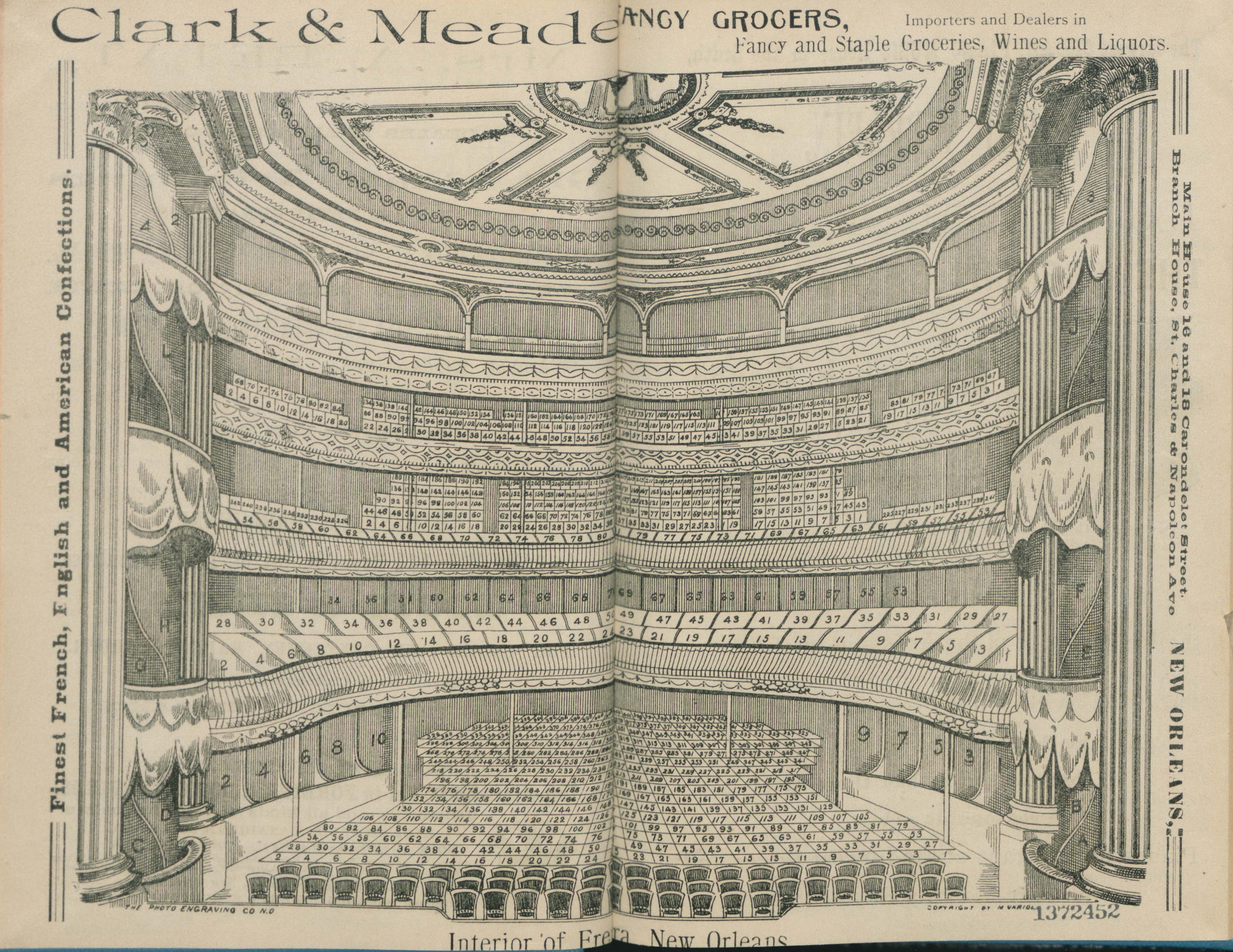
Seating Plan
This seating plan for the French Opera House appears in a copy of the libretto of Charles Gounod’s opera Mireille. The elaborately decorated theater seated 2078, including 500 unreserved seats in the fourth balcony. At the time, the theater was the largest in the United States. In 1919, just before the fire that destroyed it, tickets could be had for from 28 cents to $1.65 for matinees and 55 cents to $3.30 for evening performances.
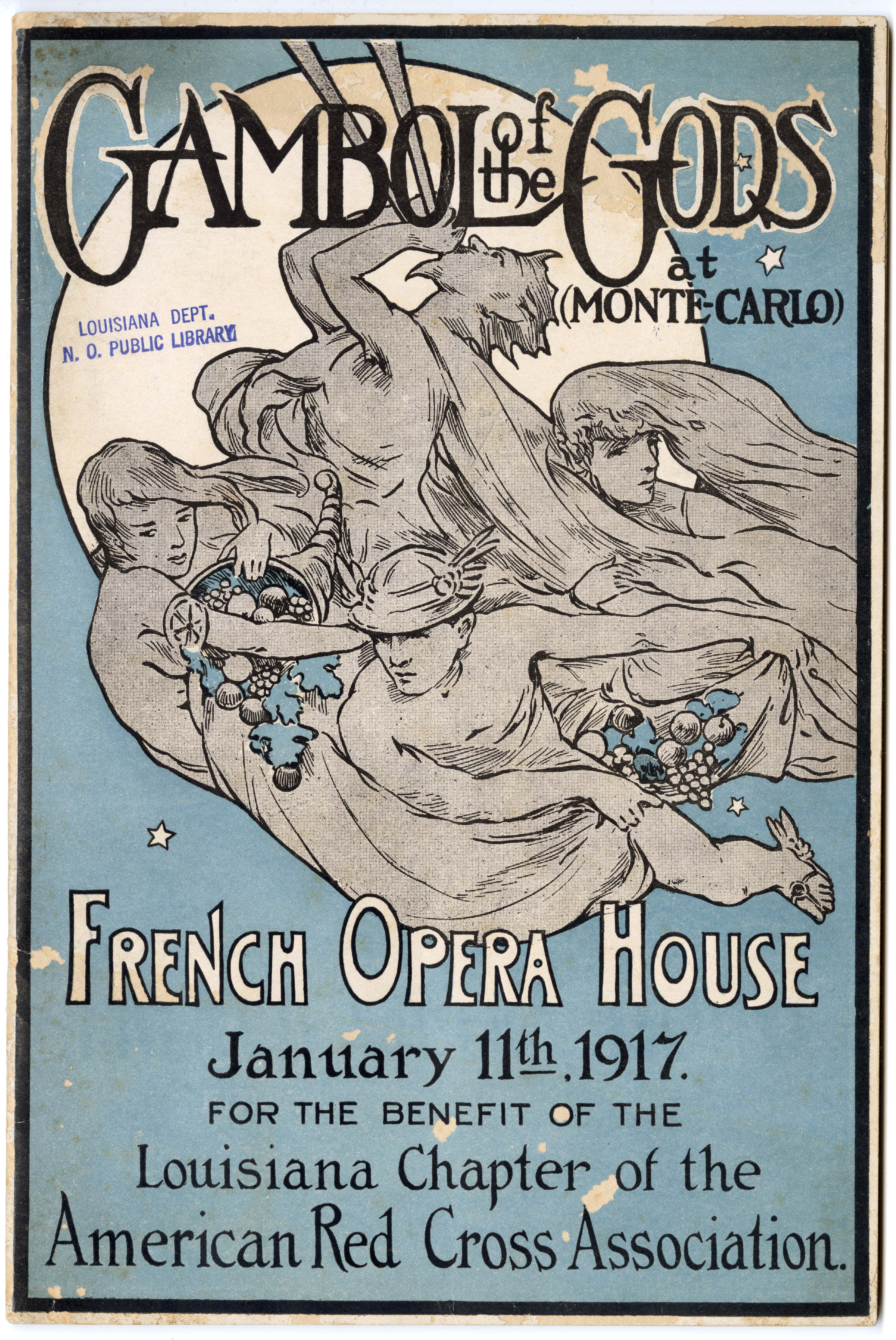
Opera Program
Program for the 1917 production of Gambol of the Gods at Monte-Carlo at French Opera House for the benefit of the Louisiana Chapter of the American Red Cross Association.
St. Peter Street Theater
From the time when Tabary first became director on March 1, 1806, to its closing, the St. Peter Street Theater, with a small assist from the one on St. Philip Street, gave at least three hundred fifty-one performances of seventy-six different operas. The works of thirty-two composers, the best in Europe, had been brought across the Atlantic and the Gulf. No other city in American and not too many in Europe could match this outpouring of opera.
Henry A. Kmen. Music in New Orleans: The Formative Years, 1791-1841. Louisiana State University Press, 1966, p. 74.
One might say that the first decade of the nineteenth century belonged to the theater on St. Peter Street; the second one–more or less–to the one on St. Philip Street.
Henry A. Kmen. Music in New Orleans: The Formative Years, 1791-1841. Louisiana State University Press, 1966, p. 76.
St. Phillip Street Theater
Before it was a theater, the playhouse on St. Philip Street was a ballroom, and it would revert to its original ballroom status several times during its lifetime, alternatively known as the Salle Chinoise, the Winter Tivoli, and, in perhaps its most famous incarnation, the Washington Ballroom. Under the ownership of Bernardo Coquet, the St. Philip Street ballroom was the scene of the first balls for free people of color, and in 1805, when it was leased by Auguste Tessier, it became the first hall to host quadroon balls. Between 1808 and 1832, when it became the Washington Ballroom, the theater competed first with the St. Peter Street Theater and later with the Orleans Theater to be the premier site of French opera in New Orleans.
J.G. de Baroncelli. Le Theatre-Francais de la Nouvelle Orleans. New Orleans, 1906.
The Creoles were attending concerts and musicales and other types of cultural entertainment while the New Englanders were worrying about trade and shipping and getting rich. Perhaps that is why no Creole ever founded a fortune that equaled some of those established in the East. But the early New Orleanians undoubtedly had more fun.
Robert Tallant. Romantic New Orleanians. New York: E.P. Dutton, 1950, p. 28.
Orleans Theater
The first brick of the Orleans Theater was laid in 1806. This new theater was conceived and the original construction begun by Louis Tabary, who came to New Orleans from Provence, via St. Dominque, in 1804 or 1805, and envisioned a grand new hall that would outshine the two theaters already competing for the loyalty of New Orleans audiences. But construction was interrupted, and Tabary’s theater did not open until 1815, only to be destroyed by fire (possibly arson) the following year. Finally, in 1819, under the management of John Davis, a Parisian who also arrived via St. Domingue, the rebuilt theater opened once more. It was the Orleans Theater that introduced grand opera to New Orleans, and until the construction of the French Opera House eclipsed its splendor, it was the place for Creole New Orleans to see and be seen.
The second Orleans Theater burned in 1866, but the ballroom attached to it survived and is shown here. Later the scene of quadroon balls, the ballroom ended its days as the convent of the Sisters of the Holy Family. Today, the Bourbon Orleans Hotel stands on the site and incorporates a portion of the original ballroom in its design.
Descriptions of the Orleans Theater are meager. It formed part of a complex of buildings which included Davis’ Hotel and the Orleans Ballroom. Together they made a “considerable pile of brick buildings. . . . with a very handsome front and interior,” according to a contemporary directory of the city. But the theater itself was neither large nor pretentious, never seating many over thirteen hundred persons. The lower front was Roman Doric with a second story of Corinthian Composite. One interesting feature inside was a section of latticed boxes for persons in mourning who didn’t wish to be seen enjoying the opera. Later on it was admitted that the loges were not well placed; that there were locations where one could neither see nor hear well; and that sound from the corridors intruded at times. But for the time and the place, it was a splendid achievement. Quite fittingly, the opening performance was dedicated to John Davis who deserved it, the announcement implied, for nothing had been spared, enormous sacrifices had been made, and “long voyages have been undertaken.” It was all true.
Henry A. Kmen. Music in New Orleans: The Formative Years, 1791-1841. Louisiana State University Press, 1966, p. 90.
Dances and Balls at Coquet’s ballroom
Dances and Balls at Orleans Theater
Most impressive were those gala nights when the Orleans Theater was joined to the Ballroom to make a huge, surely unequaled ball site. With the pit floored over to the level of the stage; the boxes closed with panels painted by the fine scene painters of the theater to represent a saloon, or a garden; an orchestra in both rooms allowing the dancers to drift from one to the other without pause–the grand masquerade balls at the Orleans fulfilled the boasts and fed the soul of New Orleans. It was gratifying to read on the front page of one’s newspaper that ‘the ballroom is without a doubt the most richly decorated in the United States,’ or that everyone agrees these balls made the capitals of Europe envious. The Orleans Ballroom was acknowledged to be both “the ornament and pride of New Orleans.’
Henry A. Kmen. Music in New Orleans: The Formative Years, 1791-1841. Louisiana State University Press, 1966, p. 20
Balls attained their highest frequency during the carnival season, a stretch of from five to eight weeks between Twelfth Night and Shrove Tuesday. The idea was to get in as much fun as possible before Lent, and in New Orleans fun meant dancing.
Henry A. Kmen. Music in New Orleans: The Formative Years, 1791-1841. Louisiana State University Press, 1966, p. 7.
Dances and Balls for Carnival
This invitation to the 1883 ball of the Krewe of Proteus is one of the few that uses French historical imagery in its design. The theme of the ball that year was, simply, “The History of France.” During the nineteenth century, costumes for the members of Proteus were manufactured in France. In 1883, however, the ship bringing the raiment to New Orleans was delayed and the krewe had to make do with a “shabby” ensemble of local garments.
Louisiana Division Carnival Collection.
Those were the days, too, of the prosperity of Louisiana, when her wealthy planters and merchants, descendants of the adventurous Frenchmen who colonized the delta of the Mississippi, looked to the motherland for their fashions, their amusements and their literature, and sent scores of their sons to Paris to complete their education. These young Creoles returned home with Parisian ideas and tastes so engrained in them that it was natural they should seek to transplant to New Orleans the theatrical, operat ic, terpsichorean and other amusements of the great metropolis on the Seine.It was in 1827, sometime before the elder Davis opened the old Orleans Theatre Ball-room, that a number of young Creole gentlemen, some of them just returned from finishing a Parisian education, organized the first grand street procession of masqueraders in New Orleans. One more splendid still, and still larger in numbers, took place on the Mardi Gras of 1837; and another, still more brilliant, in 1839.
The Music of Gottschalk
This portrait of Louis Moreau Gottschalk appeared on the cover of his compositions published by Oliver Ditson & Co. in Boston and sold by L. Grunewald Co. locally. Among the French titles in the Ditson inventory were Bamboula, Pasquinade, Dernier Amour, and Marche de Nuit.
It was Edward Gottschalk who pushed Moreau to excel in music. For this purpose he engaged F.J. Narcisse Letellier, a tenor at the Theatre d’Orleans, composer, and in his spare time a “professor of music.” A Parisian with family still in the French capital, Letellier brought his young piano student along rapidly. (p. 34)
Some of Gottschalk’s compositions from this period are most startling, notably the jaunty Pasquinade (The Clown). While the first record of its performance dates only to 1863, this sparkling gavotte almost certainly relates to this same happy post-festival phase of the composer’s life in Havana. Pasquinade (op. 59) has often been credited with being a forward-looking anticipation of ragtime and jazz. (p. 295)
Ojos criollos (op. 37), written in Saint-Pierre and labeled a Danse Cubaine, is a pure contradanza arranged for two or four hands. Its rhythmic pattern presages that of many American cakewalks, including the evergreen At a Georgia Camp Meeting. It also contains an intriguing offbeat passage that directly anticipates jazz of the 1920s. (p. 284)
Circus Square
Cayetano Mariotini, a Cuban, began to bring his circus to New Orleans in the early 1800s. He set up his tents on South Rampart Street in “Circus Square” — better known by its current name, Congo Square — where he and his wife entertained New Orleanians with equestrian acts. Cayetano’s circus became an institution in the early city and even inspired a song sung in Creole patois. In 1816, Cayetano built the Olympia Theater, adjoining his circus, but the new venture was not a success, and he soon found himself so badly in debt that he had to sign over his ten horses, a jackass, and his slave William to his creditors as security. When he died in October 1818, his debts still unpaid, the creditors brought suit against his estate, asking that the property he had signed over to them be sold. Thus, Cayetano’s circus horses went on the block.
Parish Court, #1466
The ire of the Governor had been thoroughly aroused by one of the most flagrant of all the rowdy exploits of the flatboat crews–an attack upon Gaetano’s Circus, which had been showing in New Orleans so long–apparently it first appeared in the city soon after the American occupation–that it had become almost an institution. Its many wonders were celebrated in a song, of innumerable verses, which the Negroes sang on the streets and in the market-places. It began:‘Tis Monsieur GaetanoWho comes out from HavanaWith his horses and his monkeys!He has a man who dances in a sack;He has one who dances on his hands;He has another who drinks wine on horseback;He has also a pretty young ladyWho rides a horse without bridle or saddle.To tell you all about it I am not able–But I remember one who swallowed a sword.
Bernard Marigny and Gaming
…never before has the Crescent City been sung as the birthplace of the man who first brought Craps to America. And yet to Bernard Xavier Philippe de Marigny de Mandeville, born in New Orleans in 1785, belongs this honor. A swaggering, gallant, fantastic figure, this son of a wealthy Creole planter was left at sixteen a fabulously rich orphan. His every whim indulged while his father was alive, he became as wild and headstrong after his death as an unbacked mustang, and his guardian, abandoning all idea of control, finally shipped him to England, hoping that life abroad might mend his manners; but in London Bernard’s dissipations became only more pyrotechnic, and he spent most of his time at Almack’s and other famous gambling places where a novel dice game from France, called Hazard, was all the rage. Bad reports of his dissolute living and phrenetic gambling came to his guardian’s ears and Bernard was ordered home, where he immediately taught his Creole friends this new alluring game.
…The Americans … looked down upon the Creoles as an effete, alien race and called them “Johnny Crapauds” a term of reproach the British had long fastened upon the French because of their supposed predilection for frogs as an article of diet.
When the Yankees saw the Creoles huddled about a table excitedly playing Marigny’s new game of Hazard, wagering money, slaves, plantations, and even dull gold mistresses on the turn of the dice, they slurringly referred to the pastime as “Johnny Crapaud’s” game. It’s popularity, however, spread like yellow fever in a mosquito swamp. Before long it became the passionate obsession of the whole town, of Americans and Creoles alike, and was rechristened, so it was said, “crapaud’s” and later abbreviated to “craps.”
Edward Larocque Tinker, The Palingenesis of Craps (New York, 1933), pp. 1-3.
Explore Related Special Collections
This exhibit was originally published in 1999 by Wayne Everard and Irene Wainwright. It was updated and revised by Amy DeNisco in 2024.