Female Enterprise: Women Business and Property Owners in New Orleans 1819-1927
cbryantnolalibraryorg
Female Enterprise: Women Business and Property Owners in New Orleans, 1819-1927 (2018)
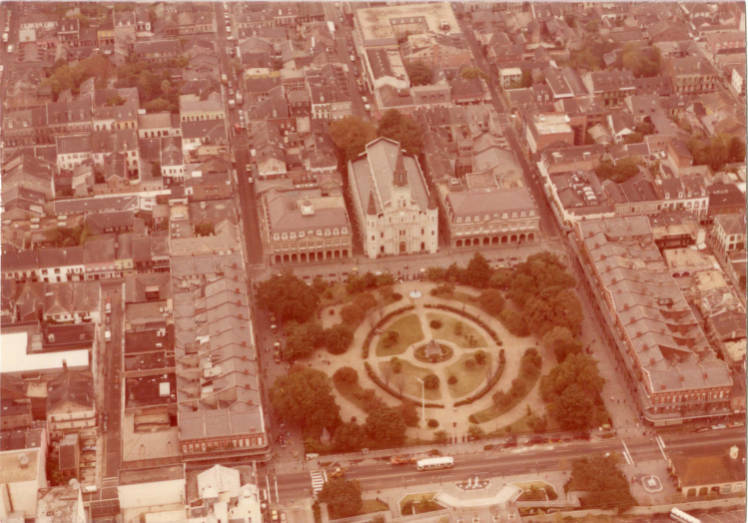
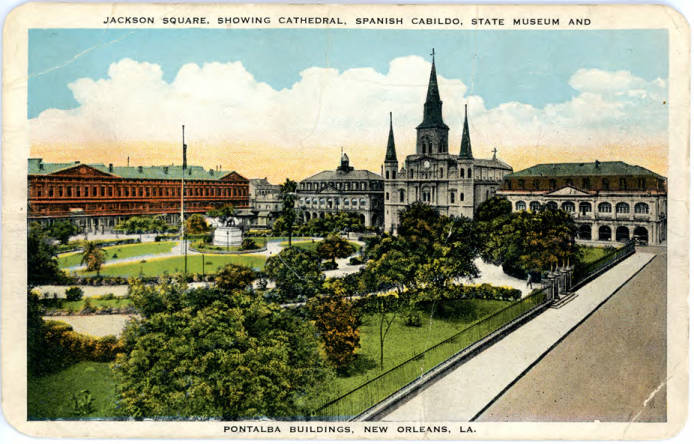
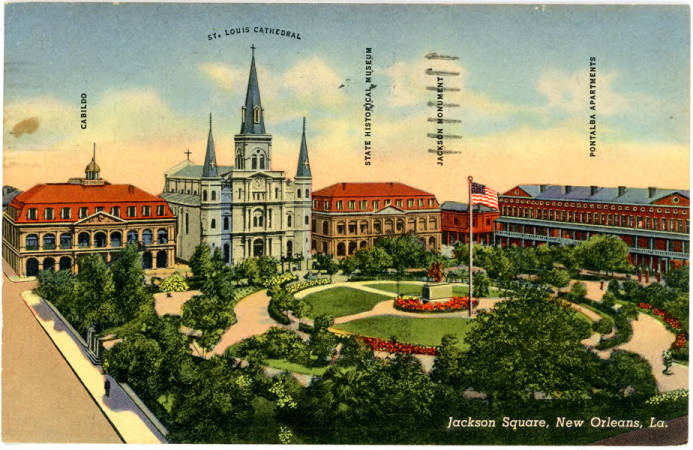
In 1849 Micaela Almonester, Baroness de Pontalba, decided to improve the property she had inherited from her father. She proceeded to have two magnificent rows of buildings erected on the Place d’Armes, in the very center of New Orleans. Baroness de Pontalba’s buildings, which still stand today on Jackson Square, are outstanding and very visible examples of the contributions women have made to the economy and the landscape of New Orleans. What is less visible, but equally significant, is the impact on the development of the city made by countless other women over the years, most of them far less privileged than Madame Pontalba.
This exhibit celebrates these contributions by describing the lives and achievements of several dozen female property and business owners in nineteenth- and early twentieth-century New Orleans, selected at random from business directories, court documents, and other general sources available in the City Archives & Special Collections. A few are well known, but many of the others lived and worked in relative anonymity. Some were successful business owners, while many struggled to support themselves and their families. Some were widows, who, despite a lack of prior experience, continued to operate their husbands’ businesses, often very successfully, sometimes temporarily. Some were single women who found their own individual avenues into the economic structure of the city. Some were wives or daughters who inherited property; others acquired real estate on their own. All had to battle the social and economic norms of a male-dominated society that made successful female enterprise far less attainable than it is today. Considered together, they provide us with a glimpse into typical female enterprise in New Orleans during the period.
This exhibit was originally created in 2018 as part of the NOLA4Women celebration of the Tricentennial of the City of New Orleans. It remained on view in the Archives from 2018-2019. Former City Archives archivists Irene Wainwright and Wayne Everard designed and wrote both the physical and digital versions of the exhibit, with the assistance of the City Archives staff. The current digital exhibit was designed and edited by Brittanny Silva in 2024.
Women in Business
Women operated numerous different types of businesses during the turn of the century. While we see ads for “traditional” female businesses, like millinery and dress shops, schools, boarding houses, and midwifery, we also see several non-traditional businesses advertised here including an undertaker, excavation service, cigar shop owner, blacksmith, and mattress maker. These business advertisements were taken from the Business Guide of New Orleans and Vicinity, 1889.
Sophie B. Wright opened the Day School for Girls, a privately funded school for white girls, in 1881. This advertisement ran shortly after she had renamed the school "Home Institute."
Arraline Brooks was a native of England. By the mid-1830s she was in New York City, dancing at the National, Olympic, Park, and other theaters. She appeared with Fanny Elssler during her American tour (1840-1841) and later performed regularly in New Orleans. In 1845 she retired and began teaching dance in the Crescent City.
In 1846, Mrs. Brooks leased the Washington Battalion Armory on Camp Street for her dance studio, balls that she sponsored, and other events. She operated at this location for about three years, later moving to Odd Fellows Hall and other venues around town. Her New Orleans season was limited to the winter months; during other parts of the year she gave lessons in such cities as Louisville, Kentucky and Natchez, Mississippi.
The Washington Battalion Armory was probably better known as Armory Hall. It stood on Camp Street across from Natchez Street until its demolition in 1881. During demolition, workers found the building’s original cornerstone, identifying it as the Camp Street Theatre (also known as the American Theatre) opened by James H. Caldwell in 1822.
In 1849 Mrs. Brooks and William Florance, her landlord, had a falling out. He accused her of not paying the rent on time; she argued that the building was in poor condition, causing her to lose business and requiring her to spend her own money on needed repairs. Through a court order, Florance forced the sale of Mrs. Brooks’ furnishings in the hall, including portraits of several historical figures.
Gibson’s Guide and Directory of the State of Louisiana and the Cities of New Orleans & Lafayette, 1838
In addition to her dance lessons, Mrs. Brooks also sponsored balls, both for children and adults, at the Armory Hall and elsewhere in the city. She even put on Mardi Gras balls, as evidenced by this notice. Daily Picayune, February 12, 1850
Eva Werner
Eva Werner was an undertaker at 211 Tchoupitoulas Street. Her story illustrates some of the problems facing an entrepreneurial woman during the antebellum period in New Orleans. The undertaking business was started by her first husband, William Schmidt, and she inherited it on his death in 1848. She married Michael Kelly in the following year, and they operated the business together for several years. He was a drunkard and wife beater, and Werner filed for separation from bed and board in 1853. That suit went all the way to the Louisiana Supreme Court, which confirmed Werner’s separation from Kelly and ordered a partition of their community property. It rejected her claim that the entire business was her separate property.
Mrs. Werner bought out her husband’s interest in the business after the court proceedings had been finalized. She advertised her purchase of the firm in the Daily Picayune. But the matter was not fully closed yet. An employee of Mrs. Werner, William C. Fluer, claimed ownership of the business later in 1854. There were charges and countercharges made in the suit that Fluer brought in Fourth District Court. In the document shown here, Michael Kelly asserts that the property belonged to his wife and that the whole suit was an attempt to defraud him. The outcome of the proceedings is unclear. We found no record of her presence in New Orleans after 1856.
Daily Picayune, September 3, 1854
William C. Fluer vs. Michael Kelly et al. Orleans Parish Fourth District Court, #8115
Julia Dean
Julia Dean was a madam who operated brothels in several locations in the years before and during the Storyville era in New Orleans. A native of Virginia, Dean was in business locally as early as 1868, when she is listed in the city directory as operating “furnished rooms” (a common euphemism for brothel) at 211 Customhouse Street. The 1870 census shows her as owning $3000 in personal property with three courtesans and three domestic servants in her household. In 1886 she purchased the three-story house at 16 Basin Street and operated there until she had to sell the property in 1897.
The three-story building at the right in this 1908 postcard was 121 Elk Place (16 Basin Street before street name and number changes went into effect). It was built for Mary Jane Kingsbury (J. N. B. DePouilly was the architect) in 1866. Mrs. Kingsbury intended to use the thirty-five-room structure as a brothel, but she and several dozen of the women who were to occupy it died in the wreck of the steamer Evening Star on October 3, 1866 during a hurricane encountered on its voyage from New York to New Orleans. In 1886 Julia Dean purchased the three-story house at 16 Basin Street and operated a brothel there until she had to sell the property in 1897 in compliance with the Storyville ordinance.
Dean and fellow madam Irma Rose opened a brothel in Chicago, hoping to generate profits there during the slow summer months in New Orleans. That project failed, however, leading to some serious financial difficulties for Dean. In later years, she had houses on North Basin Street and on Customhouse Street; she is last listed in the 1913 city directory when she was seventy-nine years old. The February 25, 1906 edition of the Sunday Sun referred to Dean at that time as “the oldest landlady in the district to-day.”
The Daily Picayune, October 25, 1908 advertised another Dean sale, this time of the contents of the house that she rented in Storyville.
Copy of an 1880 warrant for Julia Dean to be imprisoned on a charge of “having rented or hired rooms to women notoriously abandoned to lewdness.” She challenged her incarceration claiming the ordinance was null and void, and she secured her release on a writ of habeas corpus. Julia Dean vs. John Fitzpatrick, Orleans Parish Superior Court #2728
In addition to several women singled out in this exhibit, many women of color advertised their goods and services in the Woods Directory: Being a Colored Business, Professional and Trades Directory, published in New Orleans by Allen T. Woods, 1912-1914. These pages are all from the 1914 edition of the directory.
Victorine Therese Nancy Vernier Bouny
Victorine Therese Nancy Vernier Bouny was born in Jamaica in 1799 and came to New Orleans with her husband, Barthelemy Bouny, following their 1821 marriage in Cuba. Barthelemy operated a successful bakery on Chartres Street, and after his death in 1845, the business was continued under the name of Widow N. Bouny. In the 1860 census she is listed with a bakery, real estate worth $20,000, and $1200 in personal property. She sold the bakery in 1872; the building is still standing at 921 Chartres, now a multi-unit condominium complex.
Bouny's Bakery
Madame Groux Costumes
Louise Cook's Pralines
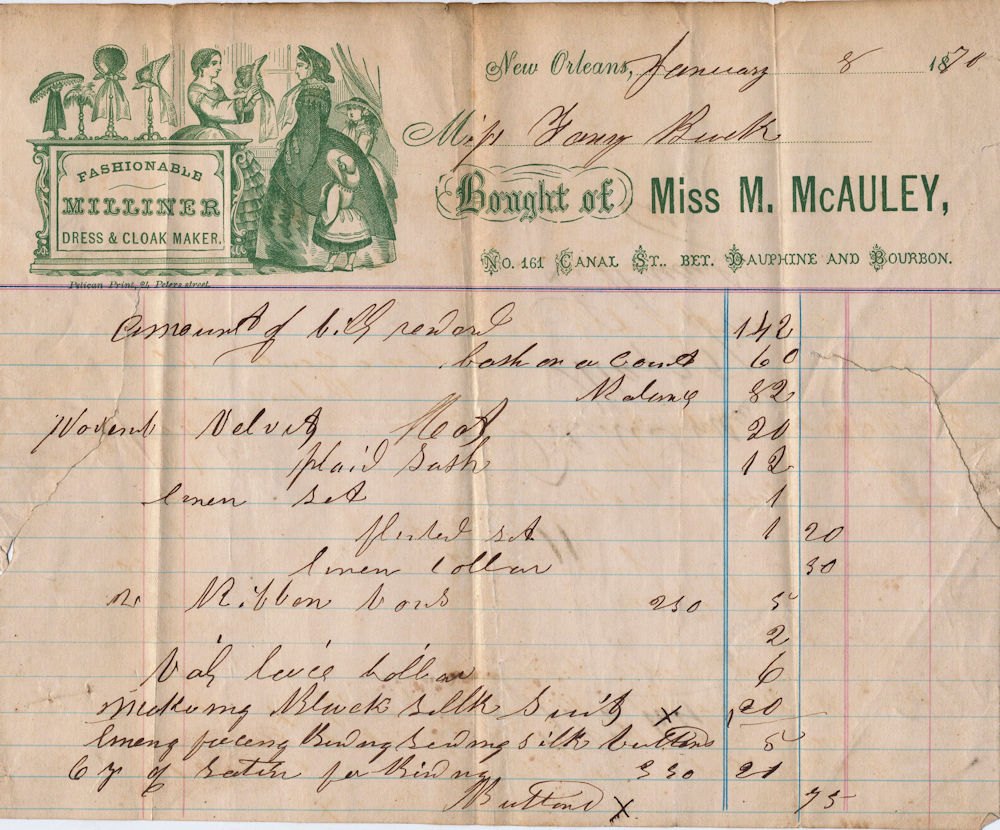
Ad for Miss McAuley's Shop
Miss McAuley Invoice
Miss McAuley Bill
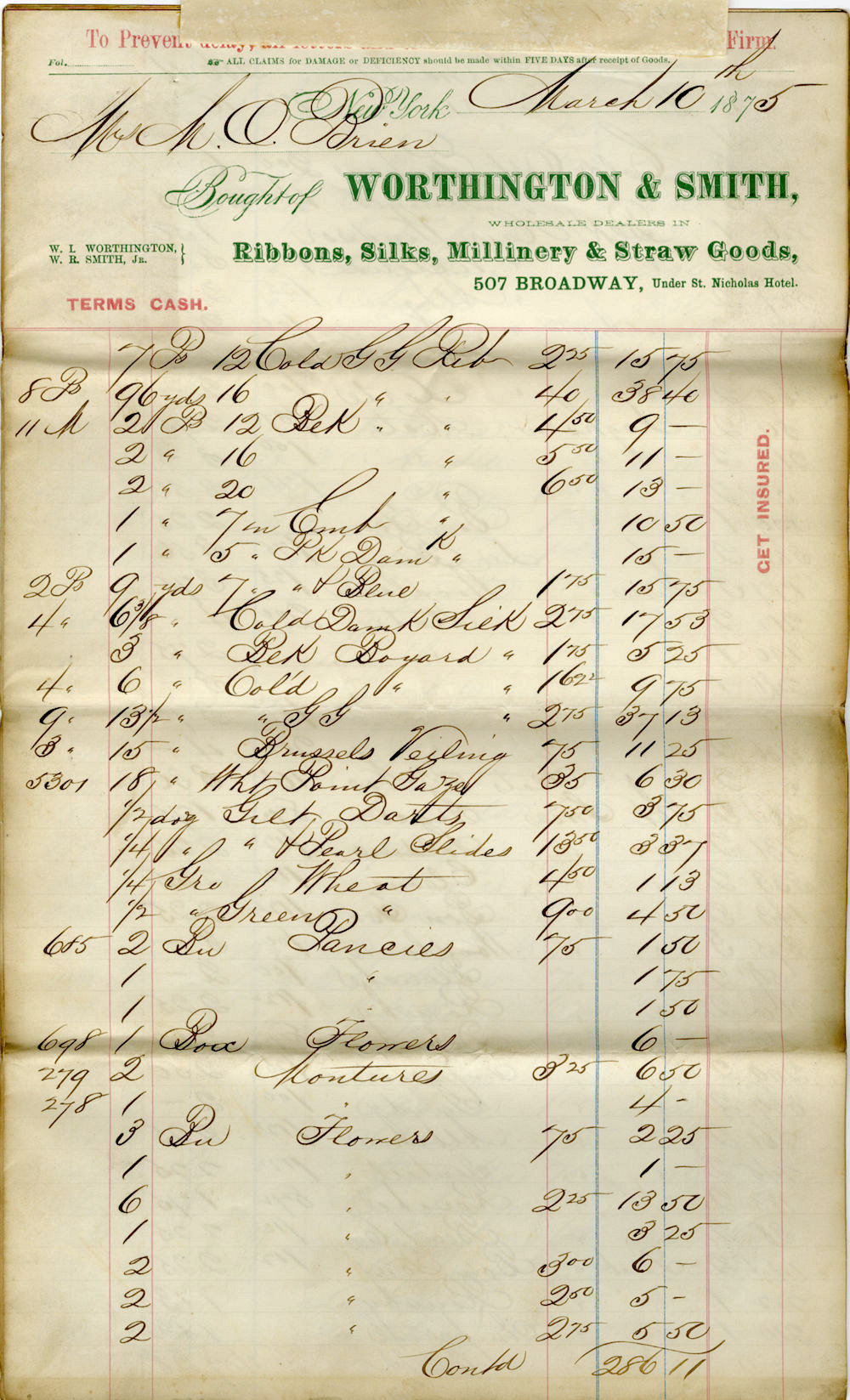
Margaret McAuley O'Brien
At the age of 26, Margaret McAuley opened a millinery shop at 161 Canal Street and built it into a successful business, importing fashionable goods from New York and abroad. In 1872, she married John A. O’Brien, a commission merchant, and continued to operate her shop. In September, 1875, while on a buying trip to New York City with her husband, she died from complications following a miscarriage. After her death, her husband attempted briefly to continue the business, but within a few months, the stock and fixtures, along with the unexpired portion of the lease, were auctioned.
Adele Pauline Deschamps
Adele Pauline Deschamps (Mrs. Jacob E. Groux by first marriage and Mrs. Pierre Joseph Fierobe by the second), a native of France, operated a costume store in several Vieux Carré locations from 1854 (possibly earlier) until her retirement and subsequent death in 1892. A February 26, 1873 article in the Daily Picayune noted that, “in her time [she] has been keeper of the wardrobe to half the theatres in Europe.” In 1882, she sued the Southern Express Company for loss of revenue due to late delivery of costumes intended for a Purim celebration in the city. Her succession shows that she owned property worth $1115.50 at her death.
Louise Cook
Louise Cook was from Iowa. We don’t know when or why she came to New Orleans, but we know that she opened a shop at 705 Common Street in 1922 to sell her handmade candies and pralines. Prior to that, she had managed the candy, magazine and specialty stand in the St. Charles Hotel. By 1923, she had moved to larger quarters at 709 Common, which also provided room for a soda fountain. She continued to expand the business, advertising regularly in the newspapers, and tailoring her ads to each holiday season. When she died in 1928, at the age of 50, the Times-Picayune wrote, “Mrs. Cook’s name was known to almost every tourist who visited the city in the past fifteen or twenty years.” Her reputation was such that the new owners of the business continued to operate in the French Quarter under the name of “Louise Cook’s Praline Shop.”
Katie Clausman Robinson
Katie Clausmann Robinson was the wife of Gustave Robinson, a mulatto of New Orleans; they married in 1895. Her husband was a partner with William Morris in the New Orleans Ice Cream Works at 2217 Dryades Street. Gustave died in September, 1910, and his widow retained her interest in the business.
Louise Llulla
Louise Llulla was the daughter of the infamous Spanish duelist Joseph “Pepe” Llulla. who was said to have fought several dozen duels during his long lifetime and to have served as a second in many more. In 1857, he purchased the St. Vincent de Paul cemeteries, also known as the Louisa Street Cemetery, as an investment (although the wits of the day said that he needed a place to bury his victims). Pepe Llulla never married, though he had several long-time female companions, including one who bore him his daughter Louise. She married a man named Manuel Suarez, who eventually assisted his father-in-law in operating the cemetery. When her father died in 1888, she became involved in a lengthy fight with her father’s last companion and his brother and sister over Pepe’s considerable estate. Louise won.
In this advertisement, published the year after Pepe’s death, Louise announces that she is now the proprietor of the St. Vincent de Paul cemetery. It is unclear why she styles herself “Mrs. Llulla,” since she was by then Mrs. Manuel Suarez (the “M. Suarez” identified as sexton in the ad). Perhaps she was capitalizing on her famous father’s name. She continued to operate the cemeteries until her death in 1902.
Margaret Haughery
Margaret Haughery was one of New Orleans’ best known and most beloved citizens – a laundress, dairymaid, peddler, baker, and entrepreneur who built up a fortune and gave it away to the poor and the orphans of the city. She came to New Orleans in 1835 and, within a year, had lost both her husband and her newborn daughter to yellow fever. She was consoled and lodged by the Sisters of Charity, who operated an orphan asylum, creating a bond that would last for the rest of Margaret’s life. Over the years, she turned various initially modest business efforts into prosperous commercial enterprises and donated the bulk of her profits to charity, primarily to the three orphan asylums of the Sisters of Charity.
Historian Laura D. Kelley describes her in an entry in the online encyclopedia Know Louisiana: “Haughery personally oversaw all aspect of her business, employing forty men whose occupations ranged from clerk to errand boy, but refusing to employ department heads. As her business grew, she investigated and invested in the latest improvements, and thus, hers became the first bakery in the South to operate machinery by steam. This efficient operation allowed her to expand even more until she had built the largest bakery in the United States.” When she died in 1882, she left charitable bequests in excess of $50,000.
In Faubourg Tremé and the Bayou Road, Volume 6 of the New Orleans Architecture series, Roulhac Toledano and Mary Louise Christovich write, “There are hundreds of examples of eighteenth- and early-nineteenth century ownership of large and small land areas in Faubourg Tremé by free persons of color.” The following documents are estate inventories and wills belonging to three women of color that show how property was passed to the next generation. Additionally, as in the case of Lolotte Montreiul, her will shows that she was able to purchase her sister’s freedom prior to naming her as the heir of her property.
Celeste Montreuil (alias Margaret Montegut), a free woman of color, died in New Orleans in 1819, leaving no direct heirs; she never married and had no children. Her nieces and nephews petitioned the Court of Probates to be put into possession of the lot of ground she owned on Royal Street, worth $2500. Her two page inventory is included above.
Agathe Montreuil
Agathe Montreuil, a free woman of color, died in 1833. In this document filed in her succession, her son, Joseph, asks to be recognized as the sole heir of her property on Bayou Road. Joseph’s baptismal record, also filed in the succession, indicates that Agathe was born a slave of the Montreuil family. Her succession is included above.
Lolotte Montreuil
Lolotte Montreuil, a free woman of color, owned a lot, with a small house and other buildings, in Tremé on Marais Street, between St. Philip and Ursulines. She also owned a slave, Elsey (alias Delcey), age 27. In 1839, she wrote her will, which tells us that she never married and had no children. She also wrote that her parents were enslaved at the time of their deaths. She herself was born into slavery, but was emancipated by her “old mistress,” Madame Manette Macarty, the widow of Francois Montreuil, in 1827 when she was 34 years old. We also know from her will that in 1827, soon after her own emancipation, Lolotte was able to purchase her sister, Adele, from Madame Montreuil. The will names Adele as her heir. This page from the inventory of her estate describes the sale of her property after her death. Her estate inventory is included above.
Photograph of Myra Clark Gaines, ca. 1855-1865. Brady-Handy Collection, Library of Congress
Myra Clark Gaines (1804-1885) was the wealthiest person — not just the wealthiest woman — in the United States during her lifetime. One estimate places the value of her estate in 1868 at more than $35 million (Elizabeth Urban Alexander. Notorious Woman, the Celebrated Case of Myra Clark Gaines. 2001). She spent most of her days, however, defending her claim to the fortune that she inherited from her father, Daniel Clark. The result was the longest-running civil lawsuit in American history. As the Law Library of Louisiana has noted in an online article, “Gaines’ resolve in pursuing her claims to justice were an inspiration across the nation, especially considering her barriers as a woman at that time. Indeed, the eulogy at her funeral lauded her, stating that ‘her name will go down in history, associated with the ideas of courage and determination’.”
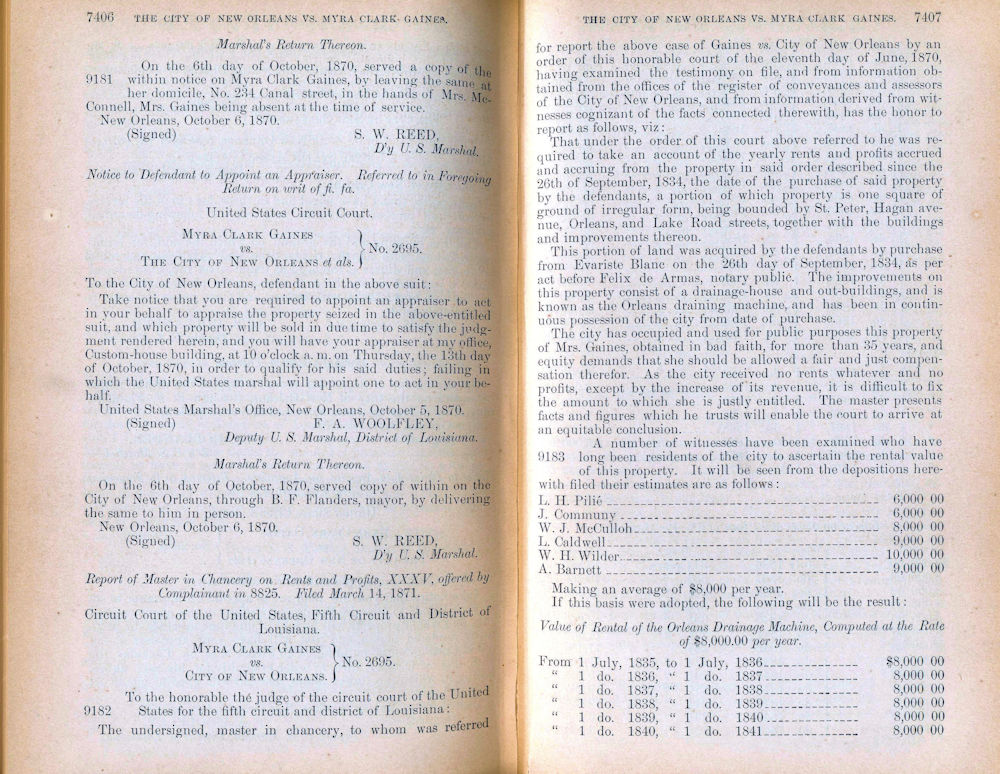
Mrs. Gaines apparently did not believe in the old saying, “You can’t fight City Hall,” as indicated by this record of her suit against the City of New Orleans. Among other things, she claimed ownership of the land on which the city’s drainage apparatus was sited, and demanded payments in lieu of rent. This excerpt from the original record appears in book seven of the eight-volume The City of New Orleans, Appellant, vs. Myra Clark Gaines, a published transcription of the city’s appeal before the U.S. Supreme Court.
The City of New Orleans, Appellant, vs. Myra Clark Gaines
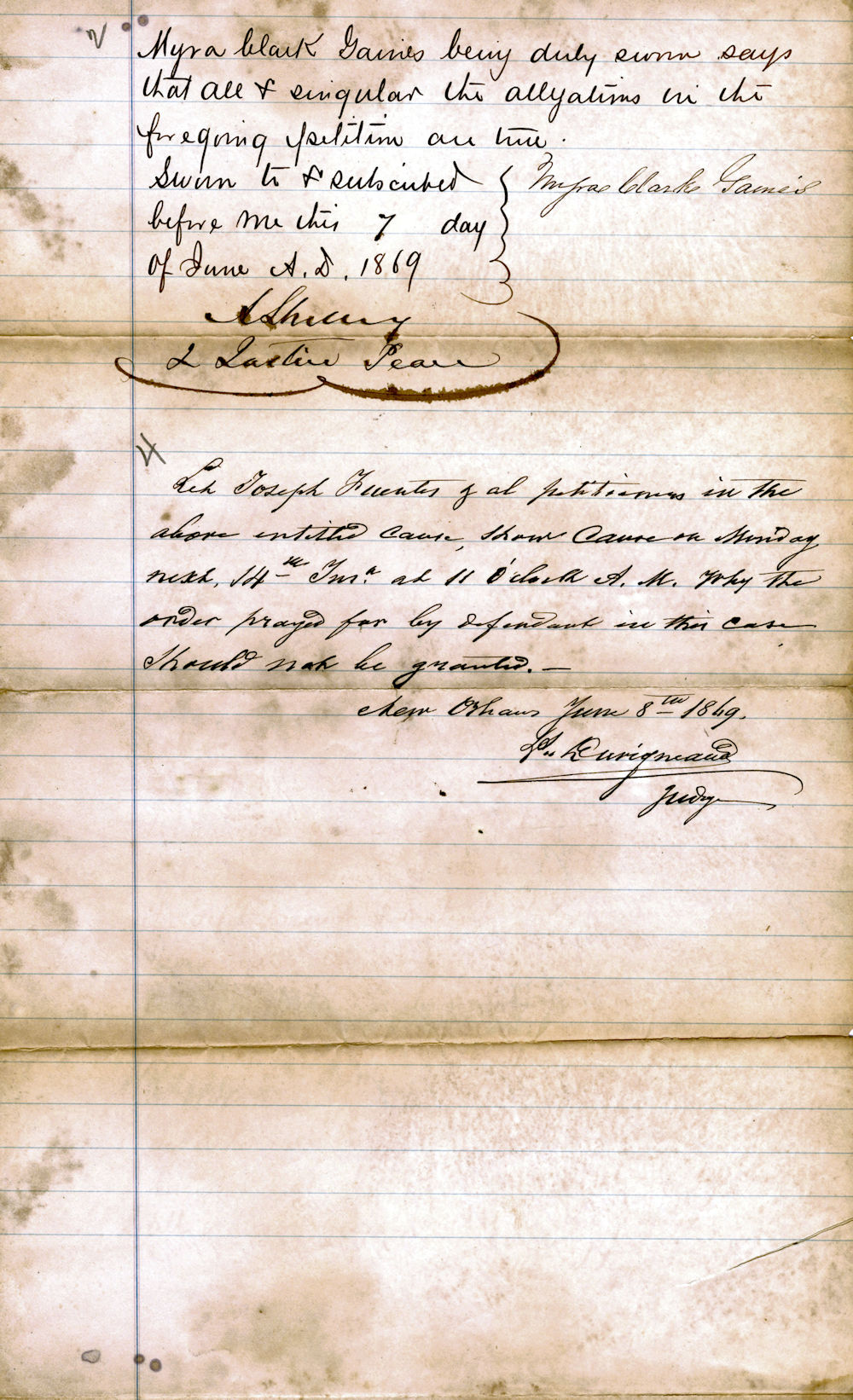
Joseph Fuentes et al vs. Myra Clark Gaines. Orleans Parish Second District Court #3299
Joseph Fuentes et al vs. Myra Clark Gaines. Orleans Parish Second District Court #3299
Mrs. Gaines’ signature appears on one of the original documents included in Joseph Fuentes, et al. vs Myra Clark Gaines, one of the many hundreds of suits filed throughout the sixty-year period of litigation over her inheritance. (Joseph Fuentes et al vs. Myra Clark Gaines. Orleans Parish Second District Court #3299)
Janet Mondelli Merriam
Janet Mondelli Merriam was the widow of Albert Walker Merriam, Captain of the Mistick Krewe of Comus at the time of his death in 1874. He was also the proprietor of Crescent Hall, the grand billiard parlor at the corner of St. Charles and Canal Streets (now the Pickwick Club, of which he was a member). Mrs. Merriam continued to operate the business after his death until she herself died on September 27, 1875.
This view of Crescent Hall below shows the building before the Henry Howard project (1874-1875) to rebuild the structure following the collapse. The statue of Henry Clay was relocated to Lafayette Square in 1900.
Crescent Hall, Jewell’s Crescent City Illustrated. 1873
Mrs. Merriam commissioned an engraving of Crescent Hall the month before she died. The three electrotypes created by the engraver were probably used to print advertisements for the business. This would have been the “new” Crescent Hall, which apparently had a “soft opening” sometime in September 1875.
We can only wonder why Mrs. Merriam would make out a promissory note to the president of the Louisiana State Lottery Company in 1874. It does suggest the possibility that she had business interests outside of Crescent Hall.
Micaela Leonarda Almonester, Baroness de Pontalba, the daughter and heir of wealthy philanthropist Andrés Almonester y Rojas, was born in New Orleans in 1795. In 1811, she married Joseph-Xavier Célestin Delfau de Pontalba, who later inherited the title of Baron from his father. The Baroness lived most of her life in Paris (the house that she built in 1840 is now home to the U. S. Ambassador to France), but spent enough time in New Orleans to oversee one of the most famous building projects in its history—the Pontalba Buildings.
Not a lot is known about Micaela’s upbringing in New Orleans, outside of her education by the Ursuline Nuns at the convent. Born into a wealthy family whose fortune came from real estate and enslaved labor, Micaela was poised to inherit a considerable sum of money and assets after her parents passing. After marrying the young Pontalba (her twenty year old cousin) in a marriage arranged by their parents, Micaela left New Orleans for France. The family dynamics that ensued are fodder for a soap opera.
Once in France, it quickly became apparent that the marriage between the young Almonester and Pontalba was meant not only for uniting the families, but for securing and appropriating her wealth. The Baron de Pontalba, intent on acquiring the Almonaster fortune, convinced Micaela to sign over her general power of attorney to her husband, allowing him to control her assets, rents, and inherited fortune. Lawsuits, separations, five children, and a constant struggle between the Baroness and her husband’s family reached its climax when the elder Pontalba shot Micaela point blank with a pair of dueling pistols. She was wounded, but survived. Her father-in-law then took his own life that evening. With the death of her father in law, her husband became the Baron and she the Baroness de Pontalba. Several lawsuits later, she finally obtained her legal separation and restitution of her property in New Orleans.
In Intimate Enemies: The Two Worlds of Baroness de Pontalba, Christina Vella dates this portrait as ca. 1840.
Photograph courtesy Louisiana State Library)
The Pontalba Buildings
Madame Pontalba is the best known of the women business and property owners included in this exhibit. We know her because of the buildings she had constructed on either side of what is now Jackson Square. Several architects and builders, and the Baroness herself, contributed to the design and ultimate appearance of the buildings. One set of plans, signed by James Gallier, was deposited in the City Archives by the Upper Pontalba Building Commission a number of years ago. The sketch below shows the sixteen individual houses that comprised one of the two rows, though it does not show the façade as it was eventually built.
Sketch plan for buildings to be erected upon the side of the Public Square, First Municipality, City of New Orleans, for Madam de Pontalba, March 7, 1849. Negative No. 883, Courtesy of Louisiana State Museum
Lower Pontalba Building
Aerial of Jackson Square
Upper Pontalba Building
Lower Pontalba Building
In 1849, the Baroness contracted with Samuel Stewart for the construction of her buildings on the Place d’Armes. Disputes between owners and builders were common during the period and the Pontalba project was no different. In 1851, Stewart filed two lawsuits against the Baroness (one for each group of buildings), alleging non-payment for work required after changes to the contract. This is page one of Samuel Stewart’s itemized bill for “extra work” performed during construction of the upper Pontalba buildings.
Samuel Stewart vs. Madame de Pontalba. Orleans Parish Second District Court, #4193
Construction on the Pontalba apartments was completed in 1851. The Baroness’s initials (A for Almonaster and P for Pontalba) are included in the ornate iron work on the balcony of both buildings.
The Baroness de Pontalba died in France in 1874. Her family retained ownership of the Pontalba Buildings until the 1920s. The Lower Pontalba Building was eventually bequeathed to the Lousiana State Museum, and the Upper Pontalba Building eventually went to the City. The City of New Orleans took possession of the Upper Pontalba Building on February 8, 1930 through ordinance #11949, Commission Council Series. The building had been purchased in December 1920 by Alfred D. Danziger, Jules S. Dreyfous and William Runkel. The building was then sold to the Pontalba Building Museum Association in 1930. This Association then donated the building to the City of New Orleans.