All New Orleans Public Library Locations including City Archives & Special Collections will be closed on Wednesday, October 22 for a Staff Development Day.

HIDDEN FROM HISTORY
UNKNOWN NEW ORLEANIANS

Introduction

This exhibit focuses on people who worked and lived in New Orleans beyond the view of tourists and business interests, who lived on the margins of “respectability,” and who struggled to survive in the urban jungle.

The last third of the nineteenth century brought momentous changes to American culture and society. The population nearly doubled, and for the first time America became more urban than rural. The growing cities were emblems of American progress and technological ascendancy, but they also generated fear. Indeed, the turn-of-the-century city harbored fear, creating a focal point for myriad anxieties afflicting late-nineteenth-century Americans. Cities, with their anonymity, their lack of community, their immigrants, their poor, their unmoored, their dark and dirty corners, threatened to dismantle the moral order even as they promised to advance prosperity and progress.

New Orleans is one of the country’s oldest cities. In the 1890s, hoping to attract tourists and capital to the ailing city, business leaders drew on the city’s long history to boost New Orleans as the city of “Old Romance and New Opportunity.” Celebrated for its cosmopolitan diversity, its international exoticism, and its metropolitan sophistication; yet infamous, too, for moral lassitude, prostitution, and political corruption, New Orleans has always embodied the contrasts and contradictions of urban life. Known as “the city that care forgot,” imagined (and promoted) as a seductress on the banks of the Mississippi, New Orleans has long been associated with a lack of consequences, a care-free kind of freedom. But for people who lived and worked in New Orleans, people who served the pleasure economy, people who toiled for the sugar, rice, tobacco, and other export markets, and for people who were unable to work at all, the city was not so indulgent, not so forgiving.

This exhibit illustrates through photographs and documents the interface between authority and poor people in turn-of-the-century New Orleans. Some of the city’s poor turned to petty crime or prostitution, while others got by selling cakes and sandwiches in their neighborhoods. Some struggled desperately with alcoholism and paranoid delusions. Others went insane on account of extreme worry or family troubles. One man was committed to the insane asylum for mania caused by love—or at least that is what the ledger book records. The stories presented here, though fragmented and incomplete, highlight the struggles of people on the margins of society and belie the image of New Orleans as a city of care-free good times.

The people grouped here may have had nothing in common except that their lives intersected with the municipality at least once. This exhibit brings them together in part to show how the city classified them. The documents and photographs here are therefore not representative of those New Orleanians who lived their lives quietly and within the law; they are necessarily skewed toward those who erred or strayed, who got caught or got in trouble, or, conversely, those who actively sought assistance from the city. New Orleans did not have much to offer the truly needy in the last years of the nineteenth century or the first years of the twentieth. Maintaining order was, however, paramount, and for this purpose the city had several choices; among them were the city jail, the Charity Hospital, the insane asylum, the poor house, and sometimes even exile. The city’s various institutions produced records, and so, this exhibit also showcases the collections at the City Archives & Special Collections. In Archives, one may find traces of people who did not leave their own written accounts or legacies, but who touched the system at some point in their lives and so had their names recorded. Some even had their pictures taken. This exhibit offers a glimpse into the lives of some of those anonymous urban dwellers, those unknown New Orleanians.

Mugshots and Bertillon Cards

This exhibit was curated by Emily Epstein Landau and funded in part by the Sexuality Research Fellowship Program (1999), a program of the Social Science Research Council, with funding from the Ford Foundation.

Dr. Landau received her doctorate from Yale University in 2005. Her dissertation, “Spectacular Wickedness”: New Orleans, Prostitution, and the Politics of Sex, 1897-1917, is a history of Storyville, the famous red-light district. She lives in Washington, DC.

The physical exhibit was on view in the City Archives & Special Collections in 2008, with an accompanying digital version designed by Irene Wainwright. The current digital version was designed and edited by Brittanny Silva in 2024.

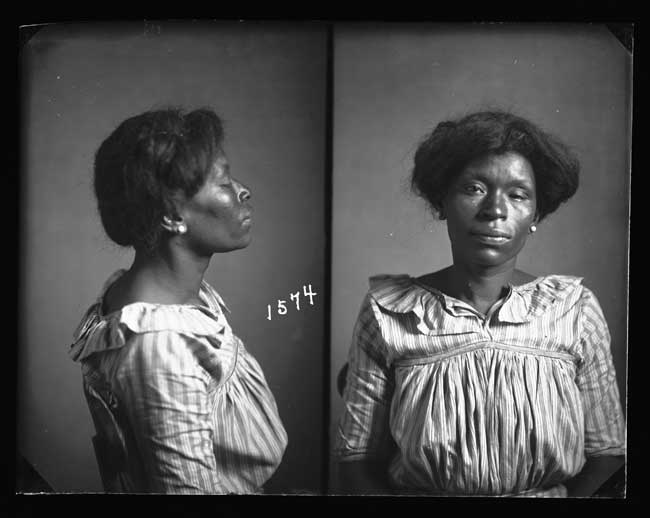
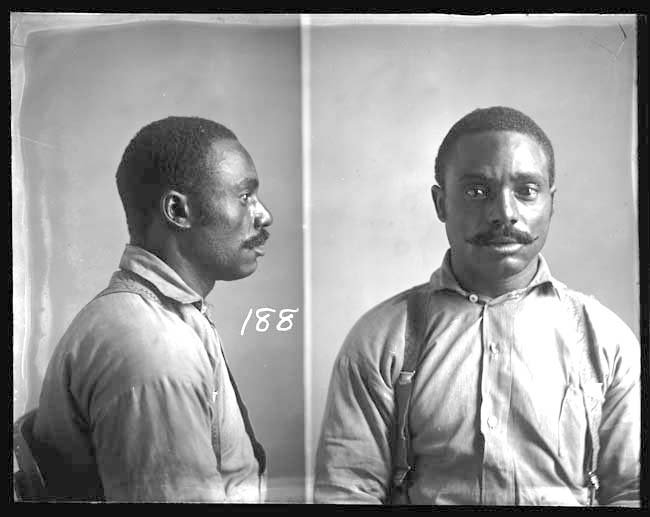
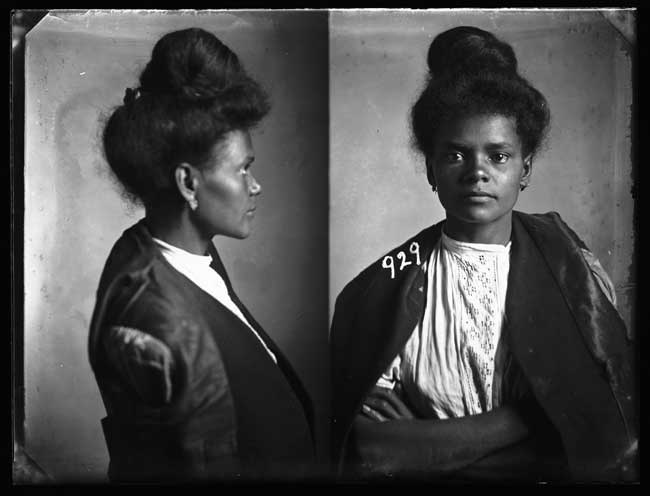
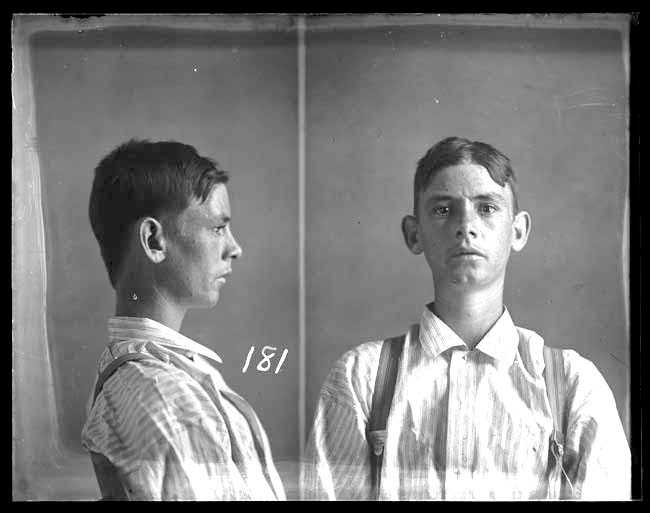
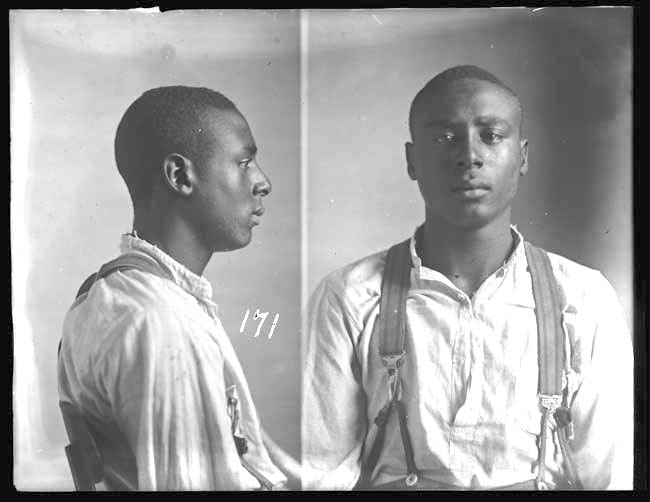
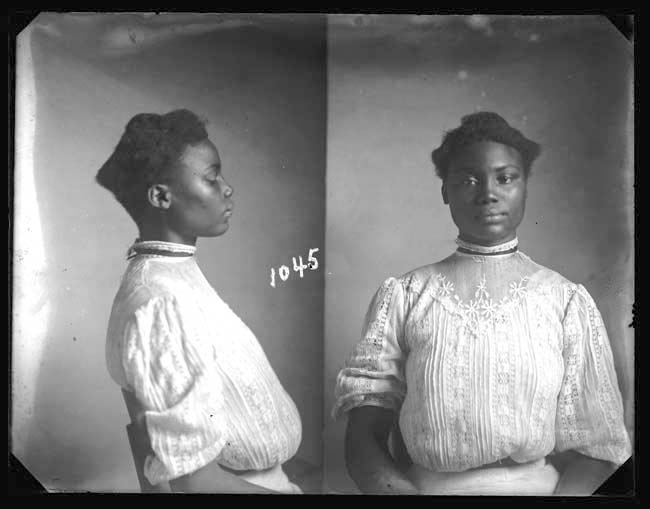
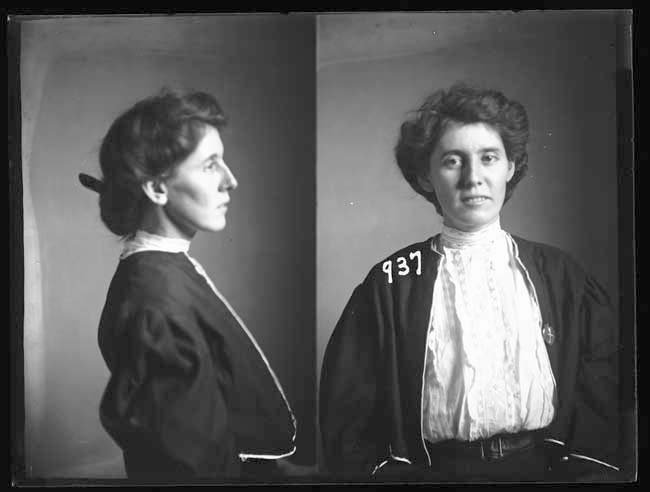
Above are a series of glass plate negatives used to create mugshots for individuals arrested at the turn of the century. (Note the number given each arrestee.) These negatives represent a fraction of the City Archives’ collection of mugshots dating from around the turn of the century and extending into the 1920s, when the technology was superseded by photographic paper. The full collection of New Orleans Police Department Mugshots have been digitized, with the accompanying information about the arrestee recorded. People were arrested for numerous offenses in the early days of the twentieth century. Among the most common was also the most vague: “dangerous and suspicious.” Others included “drunk and disorderly,” “reviling police,” “sneak thief,” “vagrancy,” and “lying drunk.” These criminal designations index a world of poverty, desperation, and hopelessness.

The identification numbers also correspond to the Archives’ collection of Bertillon cards. The Bertillon Card identification system was created by French criminologist Alphonse Bertillon in 1879 as a way of identifying and tracking individuals held in police custody. While serving as a records clerk with the Paris police department, Bertillon became frustrated with the way that photographs of arrestees were being organized. This prompted him to develop his own system of classification and organization, and introduced the science of anthropometry, or the study of measurement of the human body, as a way of identifying individuals in custody.

The Bertillon system is based on a combination of physical measurements, photographs and physical descriptions as a way of identifying individuals and repeat offenders. According to the National Library of Medicine, the Bertillon system is based on five primary measurements:

  • head length
  • head breadth
  • length of the middle finger
  • length of the left foot
  • length of the “cubit” (the forearm from the elbow to the middle finger).

When an individual was taken into custody, an officer would record these measurements along with a physical description, noting complexion, any scars or tattoos, eye color, hair color, height, etc. Information was recorded on a card, known as a Bertillon Card, which served as the arrestee’s official record. The card included a unique identification number and a frontal and profile mugshot photo. Bertillon’s system was adopted across Europe and areas of the United States, and was considered the standard in criminal identification during its time. Alphonse Bertillon was also instrumental in the development of standardized crime scene photography practices.

The Bertillon system came to New Orleans in 1897. Throughout the early 1900s the NOPD employed Bertillon operators for criminal investigation and identification. These operators were responsible for recording Bertillon measurements and photographing crime scenes. Fingerprints were incorporated into the Bertillon system in New Orleans in 1918 and can be seen on many of the cards in this collection. While much of the complexities of the Bertillon system have since been abandoned, many of its contributions to criminal identification remain. Officers no longer measure an arrestee’s forearm, forehead, and middle finger, but the recording of physical descriptions and mugshot photos continue as standard practice.

Click to view the full collection of digitized Mugshots
Click to view the full collection of digitized Bertillon cards
Men comparing photographs
Rogues Gallery of mugshots from the WPA Photo Collection

Incarceration and Hospitalization

Report of John Joiner being sent to Charity Hospital after being arrested four days prior for failure to pay a fine, 1900.

After their arrest, many individuals were placed in the parish prison; the city used prisoners to do manual labor. On occasion, prisoners used these work outings as opportunities to escape, as evidenced in the letters above. Note that the escapee described as a “habituate of Customhouse and Franklin” (first letter above) either lived or worked (or both) in Storyville, the red-light district, where she was arrested.

Charity Hospital took in the indigent. Arrest books  document instances of whole groups being “carted off” to Charity Hospital rather than to jail when found lying drunk on the street. In this case (left) a laborer from Ohio first landed in jail and was then transferred to Charity Hospital. He was arrested for not paying a fine for violating Ordinance No. 13974, prohibiting vagrancy. It is unclear why he was transferred from the jail to the hospital.

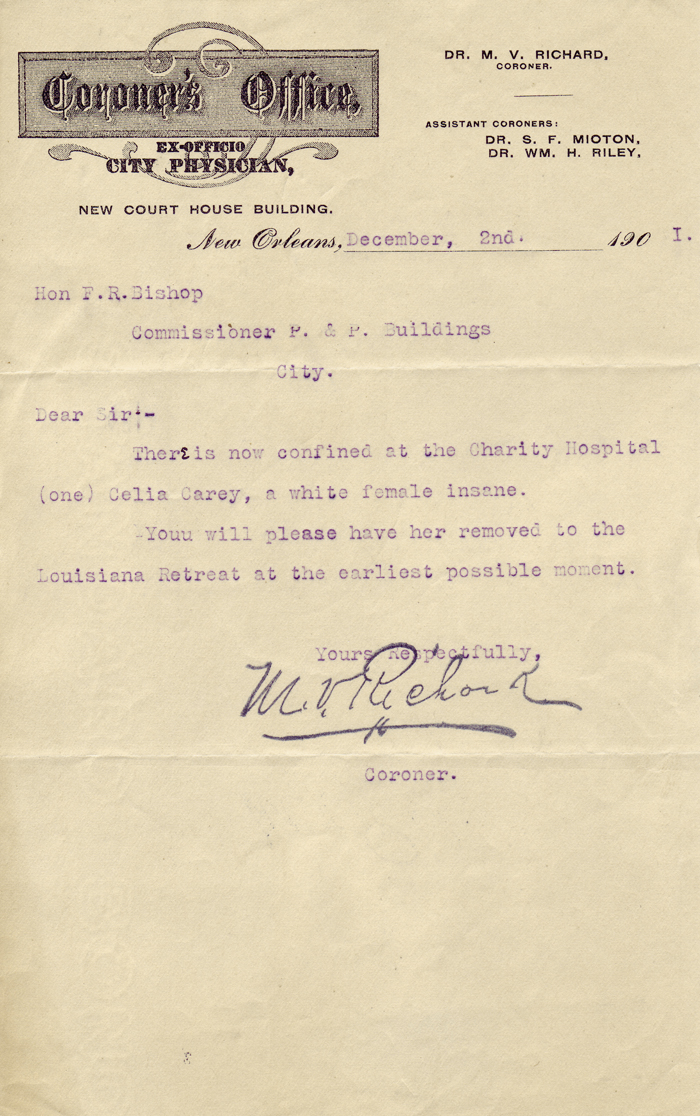
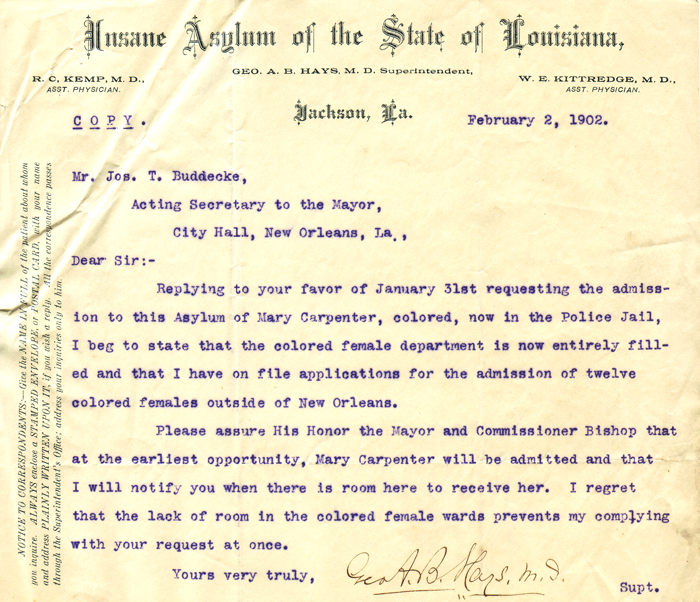
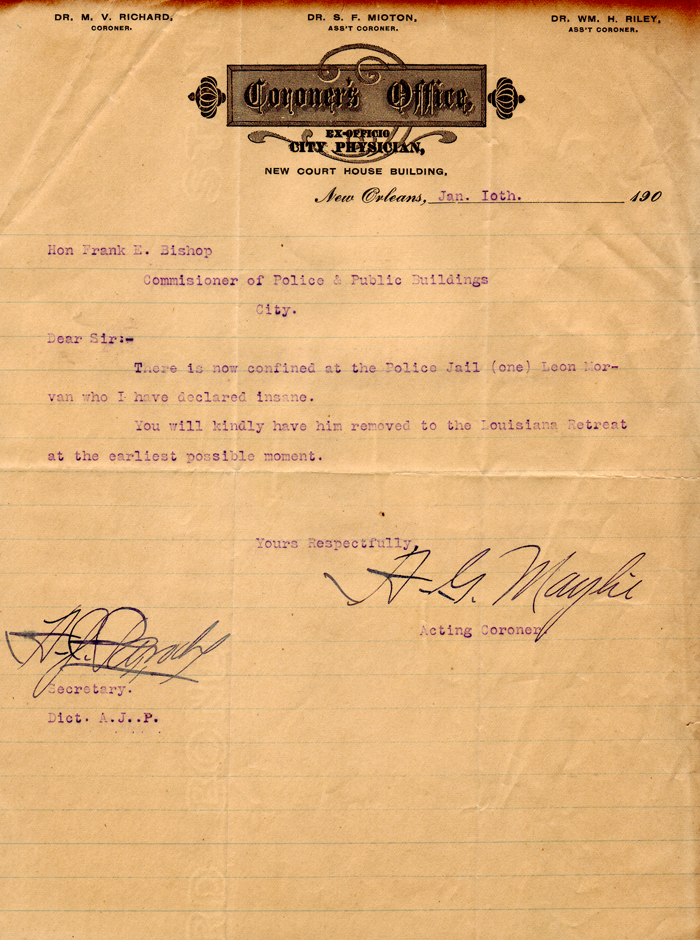
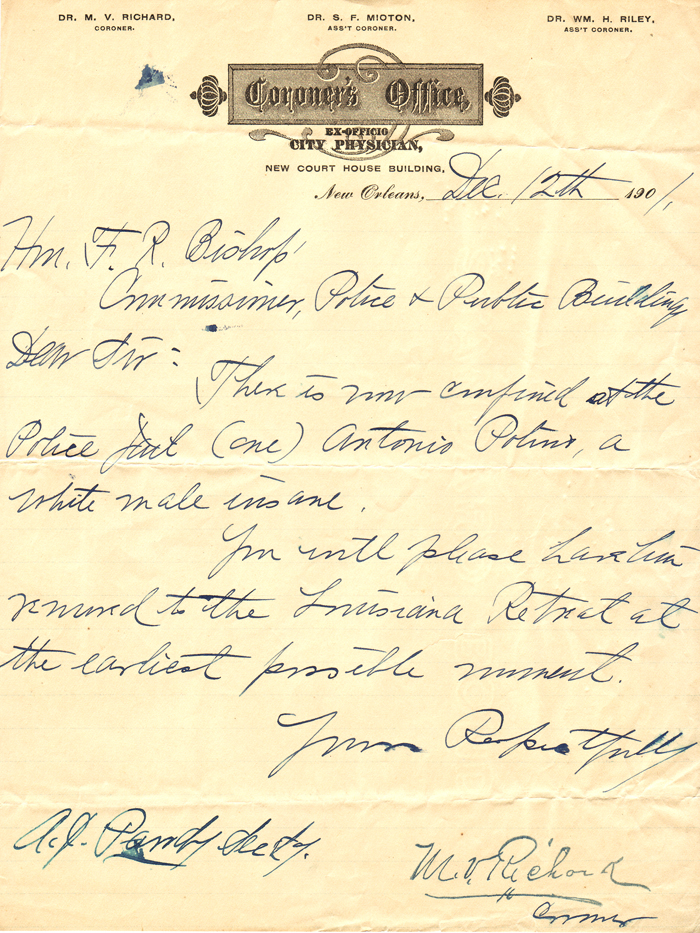
Prisoners deemed insane were sent to hospitals or asylums on the recommendation of the Coroner. The State Insane Asylum in Jackson, LA was segregated, and potential patients waited at the city jail for space in the appropriate ward to open up. The letters below outline requests for transfers from the jail to asylums, at the recommendation of the coroner. Also included is a refusal of admittance due to reaching capacity in the segregated wards of the State Asylum.

The Louisiana Retreat was a local insane asylum that inmates were transferred to, also by order of the coroner. The Louisiana Retreat was located on Nashville and Magazine, run by the Sisters of Charity.

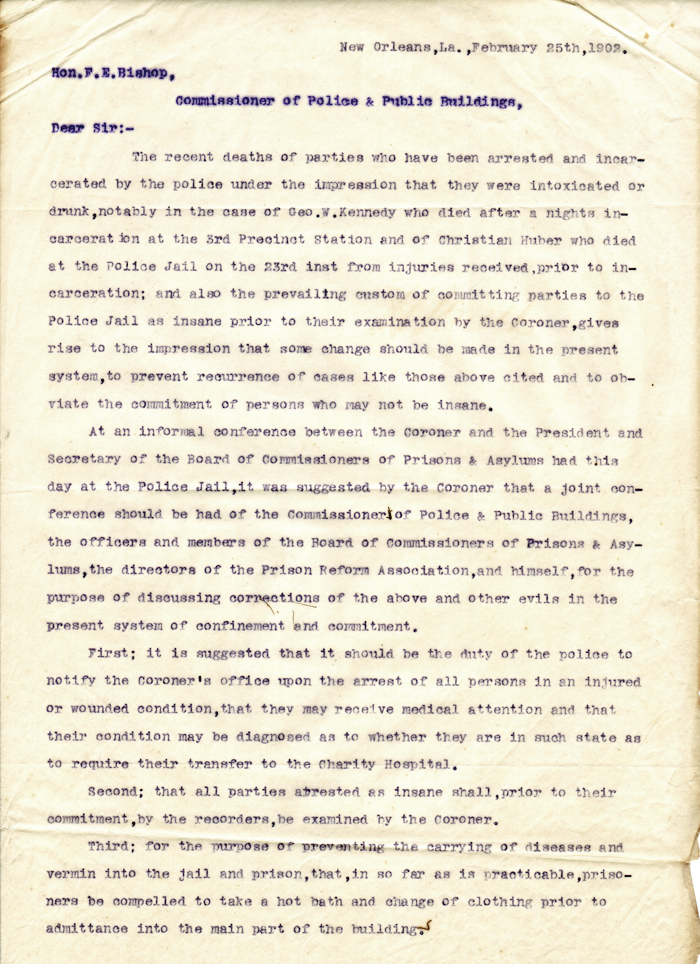
The coroner was not always consulted at the time of arrest, and often individuals did not receive necessary medical attention. Sometimes prisoners died for want of proper attention at the time of their arrest, as described in the final letter below from the Commissioner of Police and Public Buildings, Frank E. Bishop.

Charity Hospital, one of the largest institutions of its kind in the United States. Accommodations for 1000 patients and over 25,000 are treated annually for diseases of every character. Main building was erected in 1832. It is here that many sisters of Charity devote their lives to the care of the sick and wounded. Situated on Tulane Avenue.

Request to Transfer

Request from the coroner to transfer Celia Carey to the Louisiana Retreat Insane Asylum, 1901.

Request to Transfer

Refusal of Admittance

Refusal of the request to transfer Mary Carpenter from the Police Jail to the State Insane Asylum due to capacity, 1902.

Refusal of Admittance

Orders to Transfer

Orders to transfer Lean Morvan from the Police Jail to the Louisiana Retreat, 1900.

Orders to Transfer

Request to Transfer

Request to transfer Antonio Polini to the Louisiana Retreat Insane Asylum, 1901.

Request to Transfer

Death of Inmates

Report of the death of inmates while in police custody, and request for coroner's examination at the time of arrest for those in need of medical attention or arrested as "insane," 1902.

Death of Inmates

Touro-Shakspeare Home

Touro-Shakspeare Home

Orleans Parish Civil Sheriff.  Register of Patients Transported to the State Insane Asylum, 1899-1911

The Civil Sheriff was responsible for transporting individuals interdicted by the courts to the State insane asylum at Jackson, Louisiana. The Civil Sheriff’s entry book for those to be transported reads like a catalogue of woe: delusions of persecution, family troubles, onanism (masturbation), insanity caused by syphilis, insanity caused by excessive drink, insanity caused by diarrhea, insanity caused by extreme want, etc.

Note line 14 (far left): “Chas. Bolden.” This is Buddy “King” Bolden (1877-1931), the famous cornet player who, through his distinctive playing style (loud and frenzied) is said to have originated jazz. Bolden was an alcoholic who may also have been schizophrenic. He spent the last twenty-four years of his life in an insane asylum.

Almshouses and Charity

The House of Refuge offered another possibility for people unable to care for themselves or their children. Several letters are included here, written on behalf on the individuals housed there, asking the Commissioner to extend their stay.

In a letter to Mayor Capdeville, administrators of the Almshouse (poor house) sought “two squares” for farming; the almshouse was adjacent to the Boys’ House of Refuge; perhaps this served as a cautionary arrangement for the boys.

Jean Gordon writes on behalf of Frank Spellman, requesting room at the Almshouse, Mayor Paul Capedeville Records, 1900-1904

Jean Gordon was a prominent social reformer and suffragist in the early twentieth century. Her primary focus was on conditions of child labor. Her activism led to the passage in 1906 of the Child Labor Act. She was the first woman appointed factory inspector, and served in that capacity from 1907-1911. She was also a pioneer in the area of mental disability. As president of the Milne Asylum for Destitute Orphan Girls, she created programs to provide care and vocational training to mentally handicapped girls. In this letter, Gordon petitions on behalf of Frank Spellman for a place in the Almshouse.

While a major proponent for child labor regulations and protections, she was also an active supporter of eugenics and sterilization laws. Her sister Kate, was also an active reformer and suffragist who, in the end, turned against a Federal woman suffrage amendment in favor of strict state control of the franchise. She feared Federal intervention would interfere with the state’s near-total disenfranchisement of African-American men. Jean and Kate Gordon’s beliefs reflect the underlying racism that accompanied many social movements in the early 20th century.

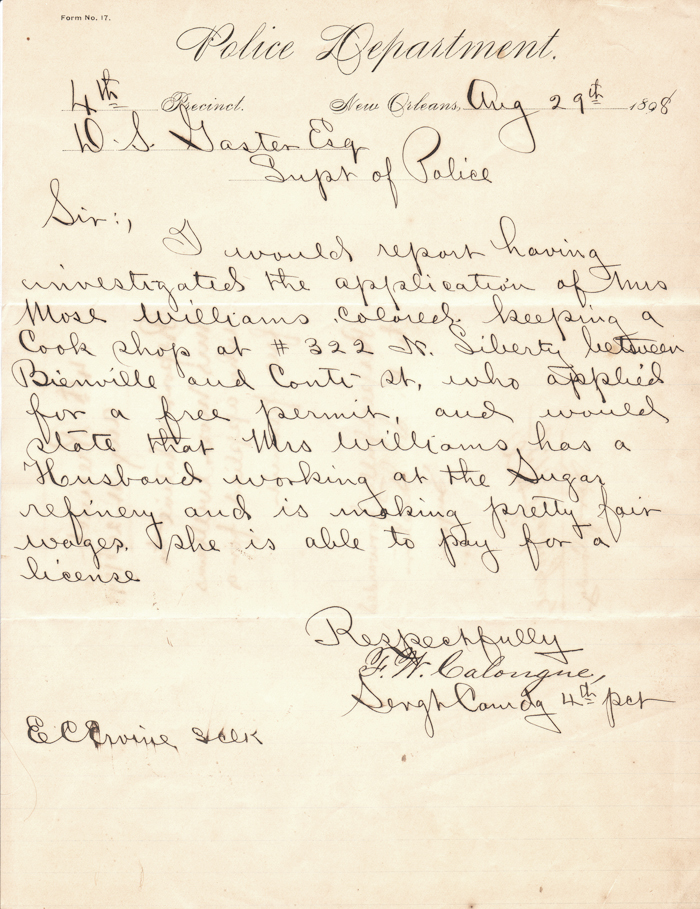
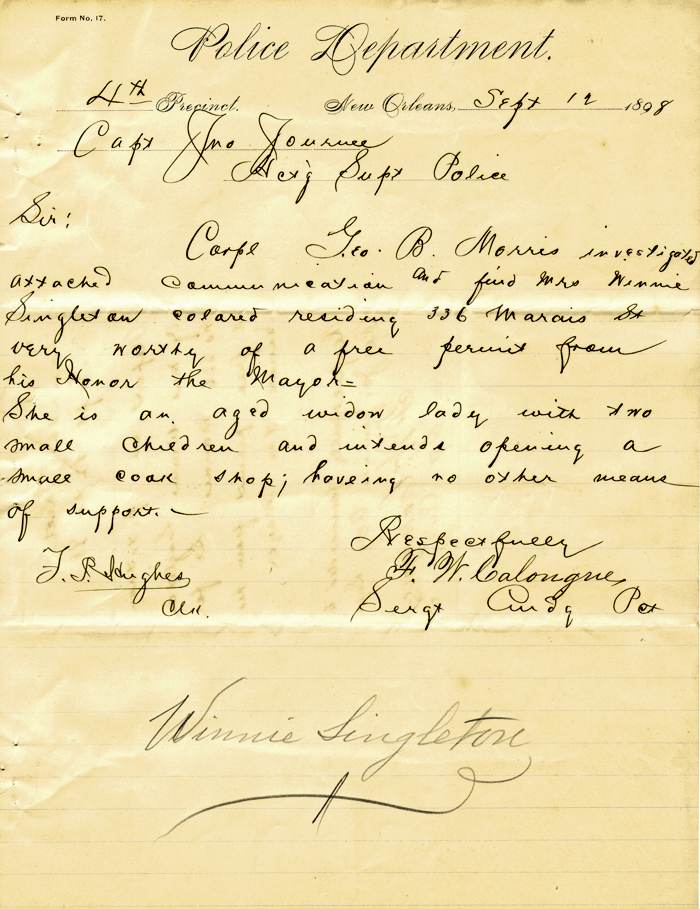
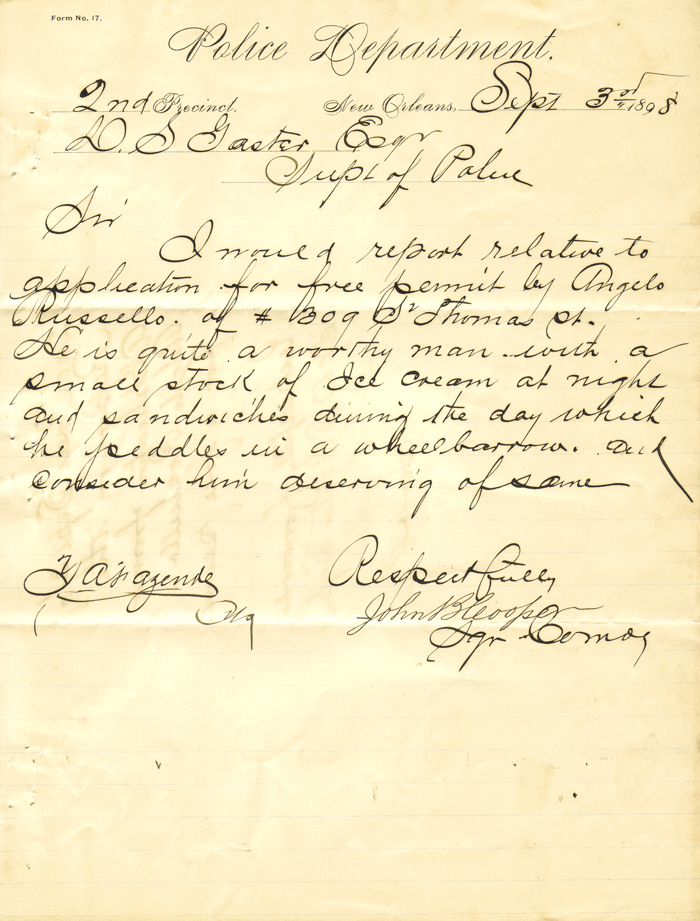
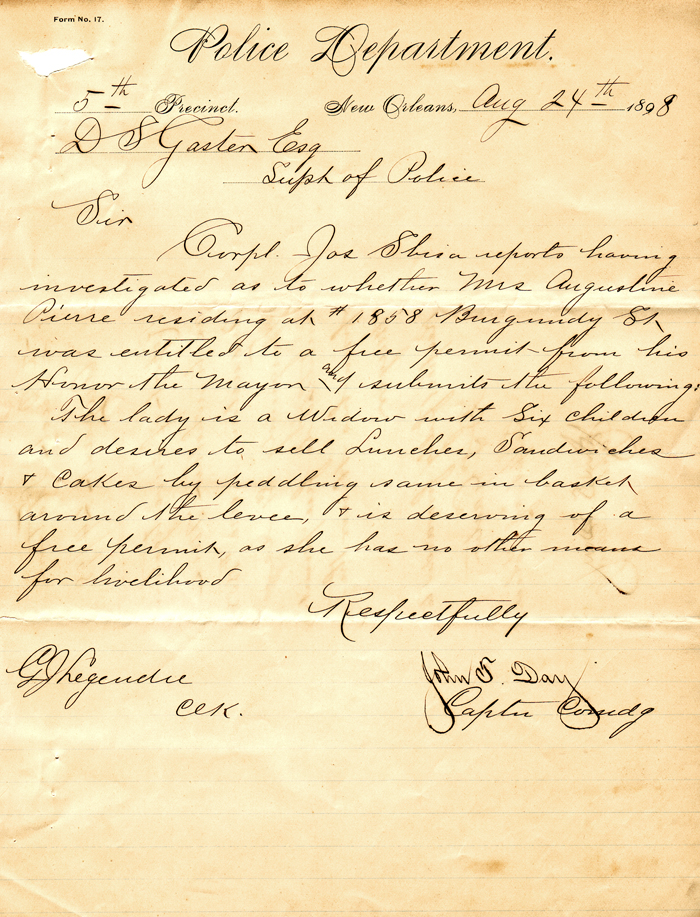
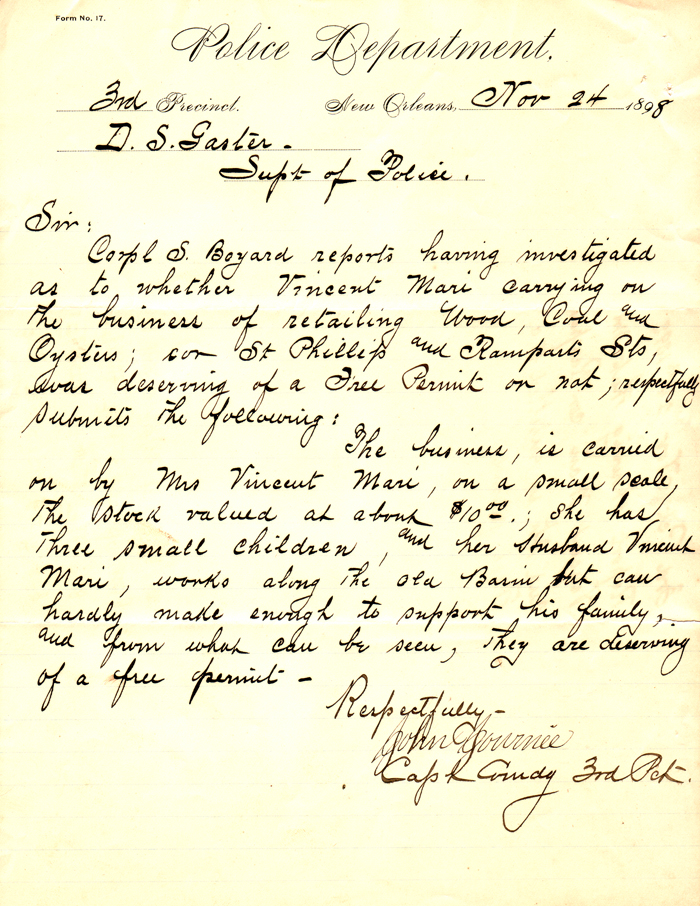
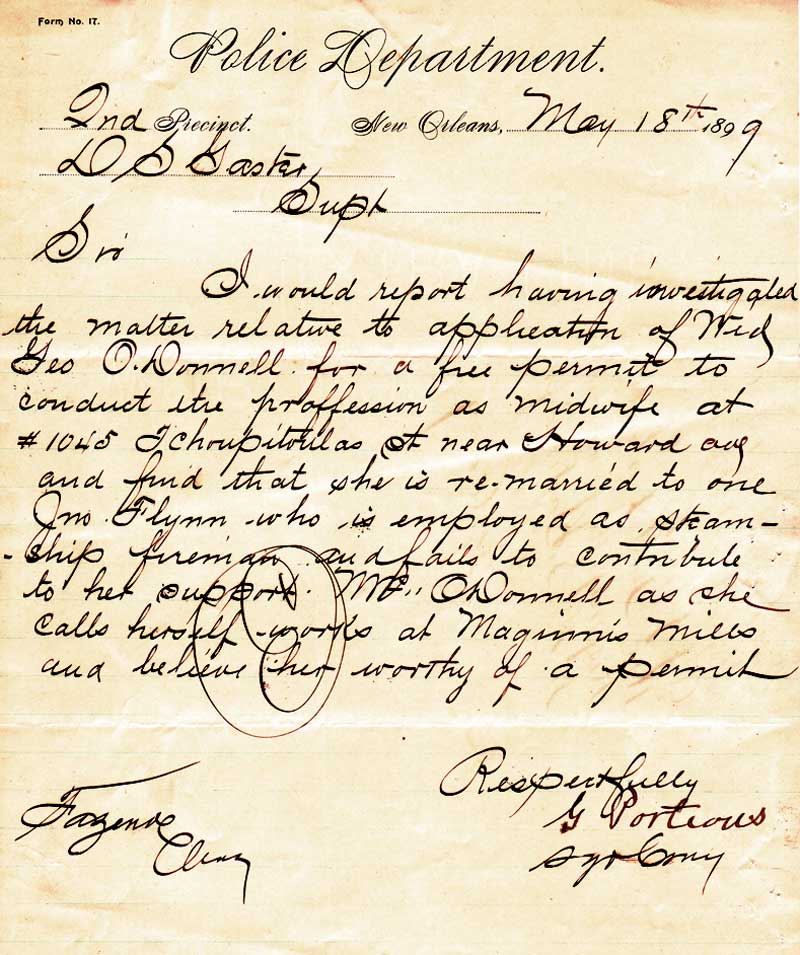
People seeking to support themselves often requested a free permit to sell materials or operate a business from their home. People who sought free permits petitioned the Mayor’s office, which sent its recommendation to the Department of Police and Public Buildings. These businesses usually consisted of peddling goods or food or selling them out of one’s house.

Not everyone qualified for a free permit; Mrs. Mose Wiliams, for example, whose husband worked at the sugar refinery, was not considered penurious enough to receive a free permit to run her cook shop. The shop, most likely run out of her residence, was located in the heart of the red-light district, Storyville. Those who did qualify for free permits were often widows or single women, or married women whose husbands were infirm or delinquent.

Some other examples of requests for permits include: A fifteen year-old-boy sought a permit to sell ice-cream from his house because his mother was unable to support the family alone; a man sought a permit to sell coal and wood; a widow desired to sell sandwiches out of a basket. The Police Department investigated and offered recommendations as to who was “worthy” or “entitled” to a free permit.

Free Permit Refusal

Free Permit Refusal

Mrs. Mose Williams' request for a free permit is denied, citing evidence that her husband works at the Sugar refinery and should be able to pay for a permit/ license.
Free Permit

Free Permit

Recommendation that Mrs. Winnie Singleton be granted a free permit to open a cook shop out of her home.
Free Permit

Free Permit

Recommendation that Mr. Angelo Russello be granted a free permit to sell ice cream and sandwiches out of his wheelbarrow.
Free Permit

Free Permit

Recommendation that Mrs. Augustine Pierre be granted a free permit to sell "lunches, sandwiches, and cakes around the levee," as she is a widow with six children and no other means of support.
Free Permit

Free Permit

Recommendation that Vincent Mari be granted a free permit to sell wood, coal, and oysters.
Free Permit

Free Permit

Recommendation that Widow O'Donnell be granted a free permit to operate a business as a midwife.

Storyville, 1897-1917

The Storyville ordinance created a single red-light district in a city long famous for prostitution. Storyville, named somewhat mockingly after the author of the ordinance, Councilman Sidney Story, became internationally known as a haven for sex, vice, and the new music known as jazz. The 1897 law limited prostitution to the area bounded by N. Basin, Customhouse (now Iberville), N. Robertson, and St. Louis streets. Ostensibly in the “back of town” this mixed-race, working-class neighborhood bordered on both the French Quarter and the Central Business District, making Storyville much more central than, perhaps, its founders anticipated.

The original ordinance, No. 13032 C.S., was passed in January, 1897, and slated to go into effect that October. It did not include St. Louis Street or the three square blocks between Perdido, Franklin, Gravier, and Locust streets, known as the “uptown” or “black” Storyville. When the City Council amended the ordinance to extend the boundaries in July, 1897, (No. 13485 C.S.) resident and factory owner George L’Hote sued the city (Civil District Court Docket #54533). He claimed that his neighborhood was then and always had been respectable. Whenever prostitutes set up shop, he claimed, L’Hote himself notified the authorities to have them removed. L’Hote’s suit went to the Louisiana Supreme Court, but was ultimately dismissed. The lawsuit delayed the official opening of Storyville until 1898, but construction of new houses of prostitution began immediately. Wood from L’Hote’s lumber factory helped build some of Storyville’s most luxurious bordellos.

Sanborn Fire Insurance Maps, Volume 1, 1896
  • Storyville Ordinances

    City ordinances establishing Storyville, extending boundaries, creating segregated districts, regulating behavior, and finally abolishing the district.

  • Lulu White Court Cases

    Explore multiple court cases filed by and against Lulu White, the most famous of the Storyville madams.

  • Mugshots and Bertillon Cards

    Browse mugshots and bertillon cards of women whose occupation is listed as "prostitute." Individuals were not necessarily arrested for prostitution; listed criminal occupations include "suspicious person" and "robbery."

  • Storyville on History Forge

    Explore census data mapped to Storyville, presented by the Midlo Center for New Orleans Studies

Lulu White, the self-styled “Diamond Queen” of the demi-monde, and the country’s “Handsomest Octoroon,” was Storyville’s most notorious madam. White had her share of run-ins with the law. Most often she was arrested for violating laws related to running a house of prostitution or selling liquor without a license; but occasionally she got in trouble for shooting, stabbing, or otherwise violently assaulting someone. The index cards above refer to the docket numbers of some of her court cases. While not all of the court case have survived, several are available to view digitally.

A postcard of the famous Basin Street in Storyville.
Storyville Blue Book, 1903

Interested (yet anonymous) parties—property owners, madams, liquor retailers—published guides to the red-light district almost every year from 1898 until 1915. They were known as “Blue Books.” Advertisements for liquor, beer, and “sure cures” for sexually transmitted diseases were interspersed among descriptions of Storyville’s best bordellos and the names of the prostitutes who worked there.

Idleness, Vagrancy, and Lewdness all fell within one general category, regardless of individual circumstances. The city passed ordinances to maintain order and to police people and behavior that fell outside the boundaries of productive citizenship. These ordinances were passed prior to the establishment of the Storyville District, but were used as the justification of policing behavior both in and out of Storyville.

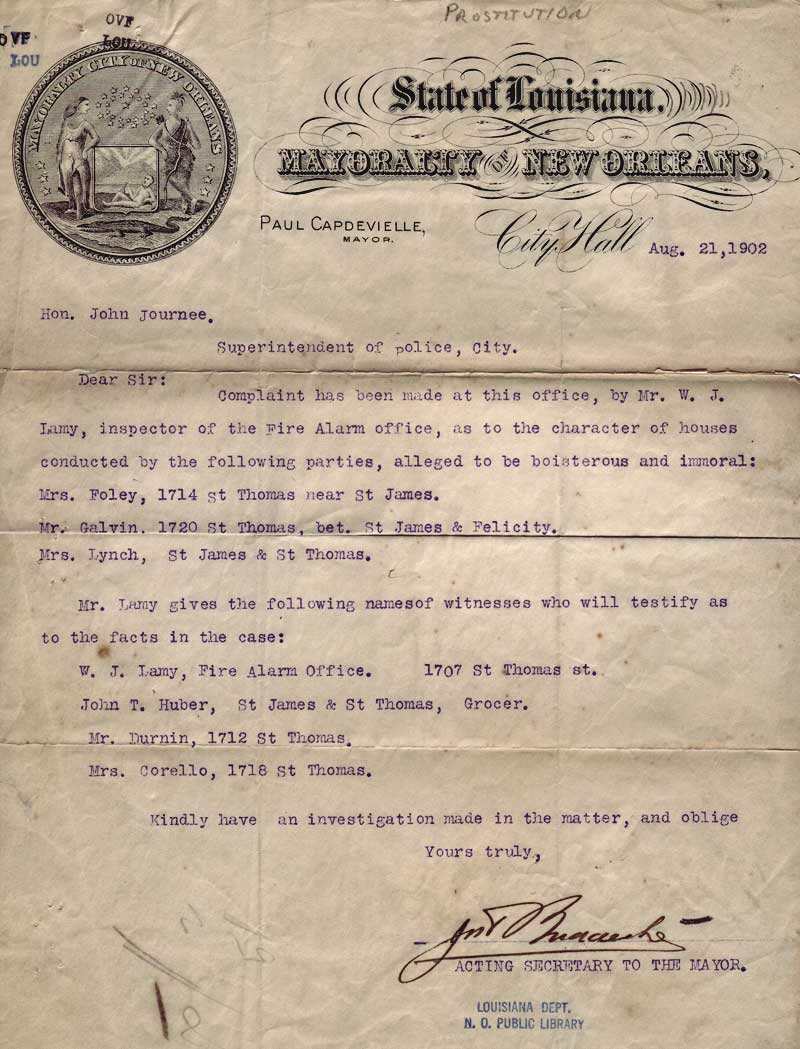
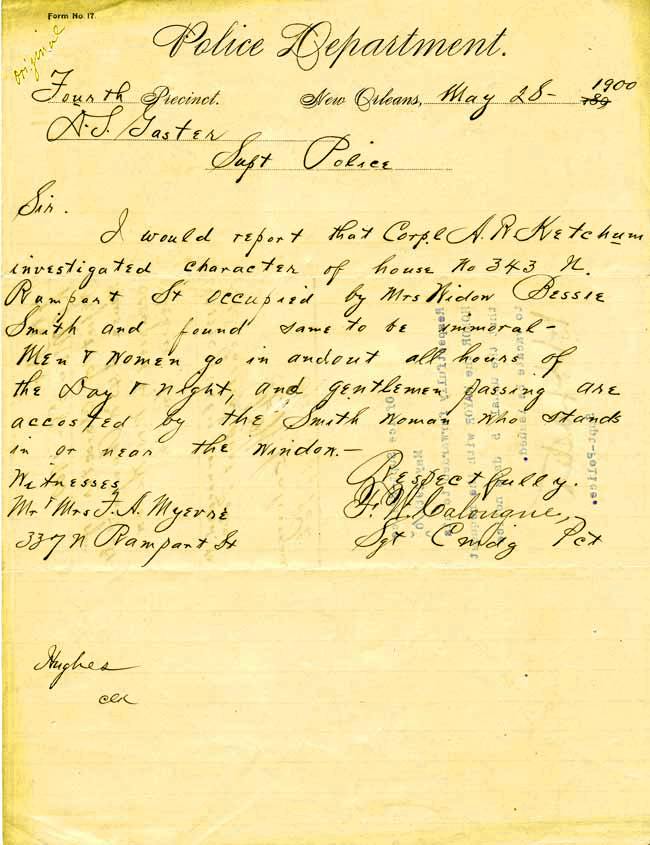
Newspapers reported derisively about women “notoriously abandoned to lewdness,” as prostitutes were then labeled, but residents and reformers alike were seriously concerned about prostitutes inhabiting neighborhoods throughout the city, offending the good people of New Orleans with their outrageous, rude, and immoral behavior.

from Ordinance No. 4434, Council Series (C.S.), 1890
Jewell’s Digest of the City Ordinances, 1882
New Orleans Daily States, October 9, 1896, pg. 6
Letter of Complaint

Letter of Complaint

Letter of Complaint

Letter of Complaint

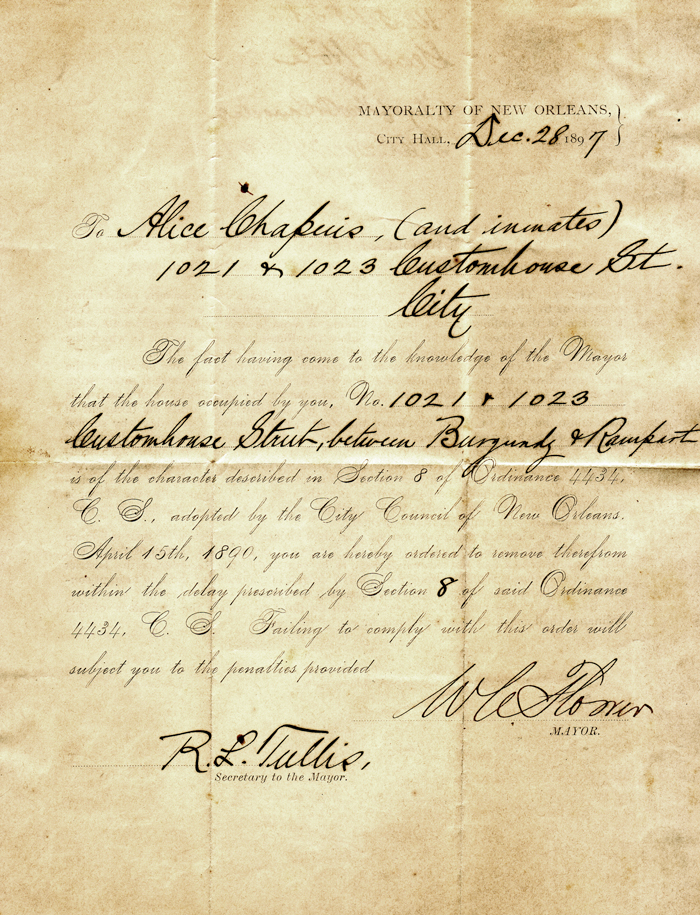
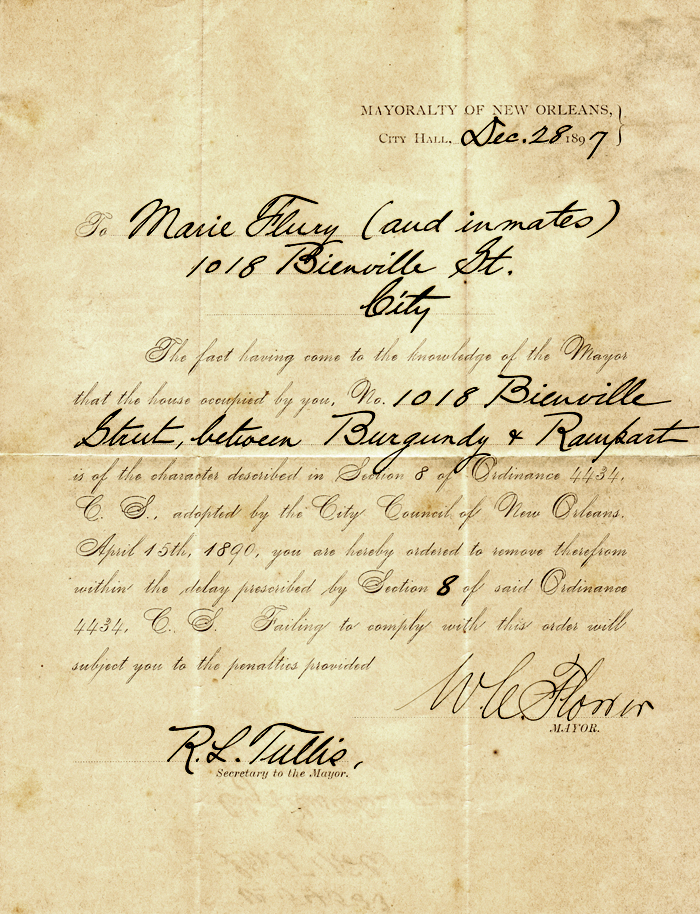
Eviction Notice

Eviction Notice

Eviction  Notice

Eviction Notice

City residents sought to maintain the respectability of their immediate environs, and the city had an interest in minimizing disorder and perceived immorality. The police, usually tipped off by neighbors through petitions or complaints, inspected “suspicious” houses and sometimes forced residents to vacate their premises. (See the two Letters of Complaint.)

The city also forced evictions when houses outside the red-light district were deemed “disorderly.” Ordinance No. 4434, C.S. was passed in 1890 and preceded the Storyville ordinance. These eviction notices appear to have been generated in some way by George L’Hote’s lawsuit against the city (Civil District Court Docket #54533).

Ordinance No. 4656 C.C.S. abolished the Storyville District on October 9, 1917 following pressure from the Navy as the US entered World War I. Soldiers were prohibited from visiting houses of prostitution and New Orleans, as a port city, posed too much of a temptation. Police raids and arrests continued in the area after its official closure. Located in the Treme neighborhood, the area has since been used for public housing, built following WWI. The Iberville Housing Development has since been demolished, replaced with a new apartment complex.

Thank you for sharing your photos with us! Please save your photos to Sneauxmageddon Photo Submissions.