New Orleans is a city built on memory, where streets, neighborhoods, businesses, landmarks, and gathering places continue to shape its identity long after they have disappeared. Lost New Orleans: Echoes of the Crescent City explores the places, events, institutions, and infrastructures that once defined life in the Crescent City through photographs, maps, documents, and artifacts from our collections in the City Archives & Special Collections. Though these landmarks and institutions are gone, their influence remains woven into the fabric of the city, preserving the culture, character, and traditions that make New Orleans unlike any other place. More than a story of loss, this exhibit invites visitors to reflect on how generations of New Orleanians have shaped and reimagined their city while celebrating the enduring legacy that continues to echo throughout New Orleans today.

Exhibit is currently on view at the Main Library.

Restaurants

Food and drink have always been a cornerstone of New Orleans life. The Archives’ Menu Collection is a treasure trove of ephemera from New Orleans restaurants, many of which have since come and gone. Researchers can explore the menu collection to see how dishes, prices, and styles of New Orleans cuisine have changed throughout the years. Here, the Archives highlights restaurants that have closed their doors for good. Hover over images to learn more.

Top of the Mart Revolving Cocktail Lounge

Top of the Mart Revolving Cocktail Lounge

This revolving cocktail lounge opened atop the International Trade Mart building in 1965. Top of the Mart closed in 2001, though was briefly replaced by Club 360. It is now owned by the Four Seasons.

Cocktail Menu
Super Popeyes

Super Popeyes

Popeyes opens in New Orleans in 1972, with Super Popeyes opening on Veterans Highway in the 1990s. The famous buffet closed in 2005 following Hurricane Katrina.

Palace Cafe

Palace Cafe

Dickie Brennan's Palace Cafe was a staple of Canal Street for 34 years. The restaurant closed in 2025.

Mrs. Drake Sandwiches

Mrs. Drake Sandwiches

Pre-packaged sandwiches sold by Mrs. Drake appeared in New Orleans in the 1930s. This menu showcases the "Mardi Gras Special," 24 sandwiches delivered to you before 10am. Mrs. Drake Sandwiches disappeared from the shelves in the 1990s.

Toney's Pizza & Spaghetti House

Toney's Pizza & Spaghetti House

Serving hungry New Orleanians from their Bourbon Street location for over 30 years, Toney's Pizza & Spaghetti House closed in the early 1980s.

Sports

Do you remember the brief years of the New Orleans Brass hockey team? Ever catch a Zephyrs game at the Shrine on Airline? Or did you watch the Pelicans when it meant watching baseball?  Here, the Archives spotlights a few sports teams that used to call the Crescent City home.

The New Orleans Pelicans were an active minor league baseball team from 1887-1959. They won multiple pennants, and played at several different stadiums around New Orleans, most notably Pelican Stadium (previously named Heinemann Stadium) on the corner of Carrollton and Tulane Aves. Pelican Stadium was also home to the New Orleans Creoles, the African American minor league team in New Orleans from roughly 1945-1952. The Creoles and the Pelicans were both active in the summer baseball clinics held at Pelican Stadium, hosted by NORD. 

Hover over images to learn more.

Pelican Stadium, 1948

Pelican Stadium, 1948

NORD baseball clinic at Pelican Stadium.

New Orleans Creoles, 1947

New Orleans Creoles, 1947

Baseball clinic at Pelican Stadium with instructions given by the New Orleans Creoles team members. The New Orleans Creoles played at their home field, Pelican Stadium, from 1945-1952.

NO_Pelicans

From 1967-1970, the New Orleans Buccaneers played in the American Basketball Association league with 5 other original charter teams. The Buccaneers moved first to Memphis in 1970 and eventually to Baltimore in 1975 when the team (and eventually the league) disbanded. The photographs below show the New Orleans Buccaneers playing home games at the Loyola Fieldhouse, circa 1967.

Bucs vs. Pipers

Bucs vs. Pipers

Basketball game between the New Orleans Buccaneers and the Pittsburg Pipers.

James Jones Jump Shot

James Jones Jump Shot

"The Buccaneers: A 65 percent increase in attendance made Loyola Fieldhouse a livelier place for he Bucs' home games during their second season in the American Basketball Association. James Jones, the Bucs' leading scorer is shown in action at left." 

Bucs vs Pacers

Bucs vs Pacers

Basketball game between the New Orleans Buccaneers and Indiana Pacers.

NO_Jazz

Our current Pelicans basketball team was established as the New Orleans Hornets in 2002, becoming the Pelicans in 2013. But New Orleans’ first NBA team was actually the New Orleans Jazz in 1974. The Jazz moved to Utah in 1979, where the team still plays. A program from the 1974 inaugural season is pictured above.

Business

At the turn of the century, Canal Street became the epicenter of retail shopping in New Orleans. The downtown street was lined with towering department stores including Maison Blanche, Godchaux’s, Mayer Isreal’s, and D.H. Holmes. Many of these businesses got their start in New Orleans and grew nationwide, while retaining their local flagship stores. While the stores have since closed, the iconic buildings have been repurposed into other retail spaces, condos, and, in the case of Maison Blanche, the Ritz Carlton Hotel. The images below highlight a number of New Orleans businesses from the past. Explore the Local Business digital collection to view additional business cards, letterhead, invoices, and blotters from historic businesses in New Orleans.

Hover over images to learn more.

D. H. Holmes

D. H. Holmes

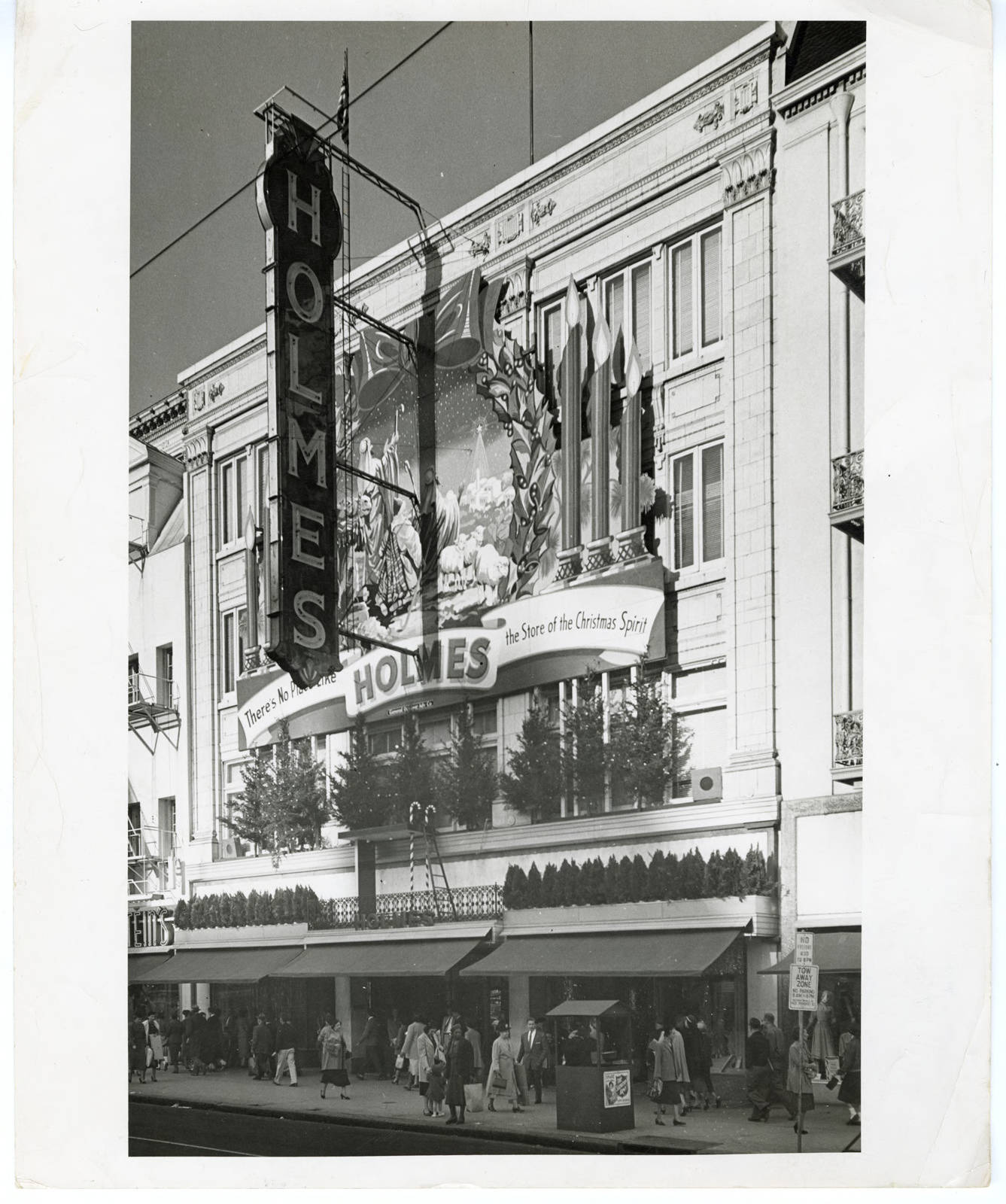
D. H. Holmes Department store decorated for Christmas Holidays. "There's no place like Holmes the store of the Christmas Spirit."

D.H. Holmes opened its flagship store on Canal Street in 1849 and closed in 1989 when it was bought out by Dillards.

Maison Blanche, 1906

Maison Blanche, 1906

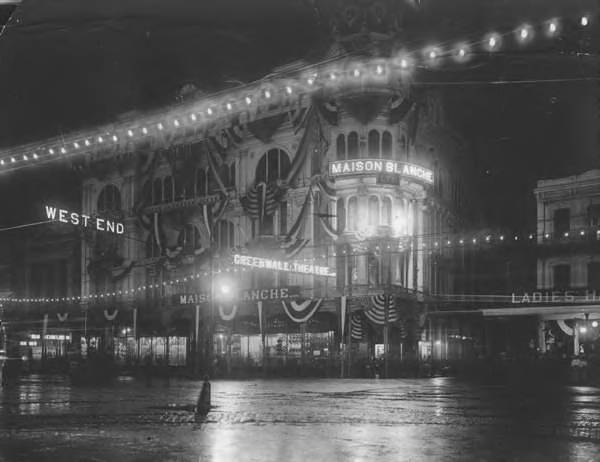
900 block of Canal St, night of the Proteus Parade.

Maison Blanche opened in 1897; this image shows the original building at 901 Canal Street. 

Maison Blanche

Maison Blanche

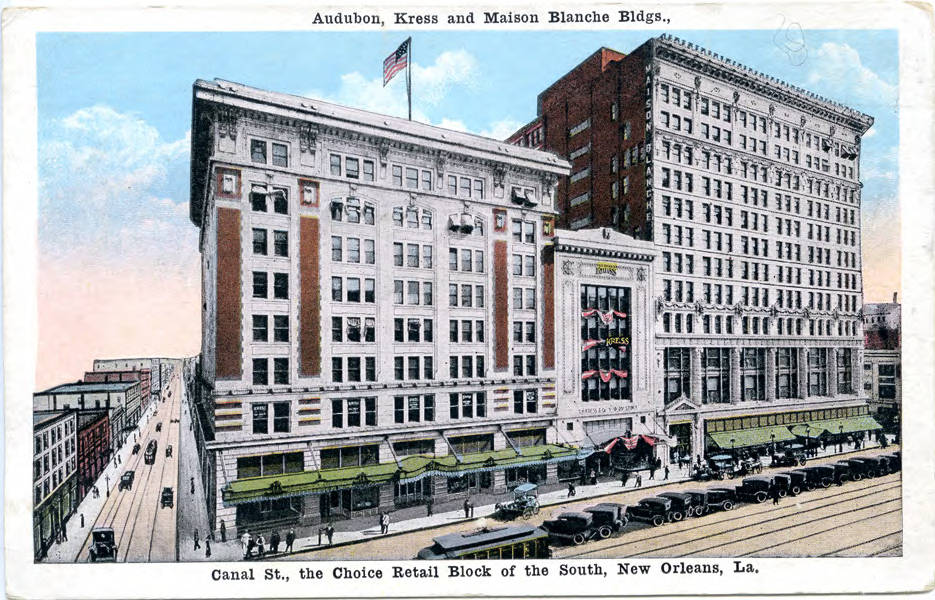
The towering twelve story building (right) replaced the original Maison Blanche store in 1909, making it one of the largest department stores in the city. Maison Blanche was also bought by Dillards and eventually closed in 1998. 

MaisonBlanche1927
Myers Isreals Business Card
Mayer Isreal's Department Store, 1906-1950s.
Flastaff Brew Company Business Card
Falstaff Brew Company, 1936-1978
Jax Brewery Business Card
Jackson Brewing Company, 1890-1974

Infrastructure

Here, the Archives spotlights the changing landscape and infrastructure of New Orleans through public buildings and municipal action. The 1950s was a time of dramatic change to the New Orleans landscape, with Mayor Morrison leading the charge for modernization in the City. During his tenure, New Orleans moved to the Home Rule Charter (which we still currently operate under), and sought to consolidate the physical footprint of city government by creating the Civic Center, with Duncan Plaza at its center. Duncan Plaza was to function as a central greenspace surrounded by a complex of civic buildings, including City Hall, State and Civil Court Buildings, and the Main Public Library. For years, the city had championed the need for a new Main Library, as the public’s needs had long outgrown the existing Carnegie building on Lee Circle. The Civic Center was completed in the late 1950’s, with the Main Library opening in 1958. This coincided with the demolition of the Carnegie Main Library. 

Below, we highlight other changes in the New Orleans landscape through the demolitions of public buildings (The Rivergate and Southern Railway train station), the construction and dismantling of the M.A.R.T., and finally, we share aerial photographs from the oak-lined Claiborne Avenue, prior to building of the I-10 overpass. Hover over images to learn more.

The New Main Library Building, 1955
Main Library, Lee Circle

Main Library, Lee Circle

Exterior of the Carnegie Main Library on Lee Circle, ca. 1946. Demolished in 1959 after the building of the New Main Library in the Civic Center.

Images from the demolition of the Main Library at Lee Circle, 1959.

The Rivergate

The Rivergate

The Rivergate International Exhibition Center sat at the intersection of Canal Street and the river, alongside the International Trade Mart. Together, these two buildings were believed to usher in a boom in international tourism. The Rivergate was demolished in 1995 to make way for the Harrah's Casino.

The Rivergate

The Rivergate

Mid-Century Modern exhibit hall and convention center designed by Curtis and Davis; Construction completed in 1968 and demolished in 1995.

Southern Railway

Southern Railway

Built in 1908, Southern Railway train terminal operated at the intersection of Canal and Basin Streets for almost 50 years. It was demolished in 1955, after the Union Passenger Terminal opened and consolidated all train traffic.

MART

MART

The Mississippi Aerial River Transit (MART) was the premier attraction of the 1984 World's Fair in New Orleans. It was shut down in 1985, but the towers remained in place until 1994.

MART

MART

The aerial gondola connected the East and West Banks, with rider traveling in passenger cars suspended 300 feet above the Mississippi River.

On February 9, 1966, a photograph ran in the New Orleans State-Item depicting oak trees uprooted along a stretch of Claiborne Avenue. The caption reads, “Mighty oaks bow to progress on N. Claiborne Ave; Neutral ground being cleared for highway construction.” The article tells the story of the Parks Commission digging up an estimated 40 oak trees to transplant along Orleans Avenue. Only some of the trees are to be moved; those too large will be destroyed.  Construction of the I-10 Claiborne Overpass started with the removal of the parade of oak trees that lined this bustling commercial corridor. The construction continued over the next three years, displacing hundreds of African American businesses and residents, and forever changing the physical and cultural footprint of the neighborhood.

The images below are taken from the Archives’ Aerial Photograph Collection, all dated from 1949. They showcase Claiborne Avenue prior to the construction of the overpass, which tore through the thriving African American commercial district in the Treme neighborhood. Because of the aerial view, the dominant features of these photographs are the oak trees that lined Claiborne. 

Hospitals

New Orleans has seen the opening and closing of many hospitals throughout our history. Here, we take a look at some of the hospitals, pharmacies, and infirmaries that have closed.

Doctors George W. Campbell and J. Monroe Mackie opened the Circus Street Infirmary in New Orleans during the month of August, 1841 on what is now South Rampart Street between Poydras and Perdido. (South Rampart St. was formerly called Circus St. until ordinance 395 C.C. changed the name in 1852.) The Circus Street Infirmary was one of only a few hospitals in New Orleans that admitted enslaved persons. According to a Times Picayune advertisement from 1841, their terms of admission upon opening were as follows: $1-$5 per day; $1 per day for enslaved persons. These prices covered admittance, treatment, and stay at the hospital, but did not cover surgical operations.

The Circus Street Infirmary opened as New Orleans experienced an increase in cases of yellow fever; yellow fever deaths jumped from just 3 in 1840 to 594 in 1841. New Orleans would see these numbers double over several years of the yellow fever epidemic. By the end of August 1841, of the 29 patients hospitalized at the Circus Street Infirmary, 18 of those  were yellow fever cases (Times-Picayune, August 28, 1841). The volume to the right is an account book from the Circus Street Infirmary, listing supplies, drugs, and other materials purchased from the Morgan & Co. Pharmacy (17 Canal Street). It spans just before the Infirmary’s opening in 1841 through the first few months of 1842.

By 1885, the Circus Street Infirmary had closed its doors and its contents were being sold off, according to an advertisement placed in the Times Picayune in September 1885. 

Circus Street Infirmary account book

Circus Street Infirmary account book, 1841

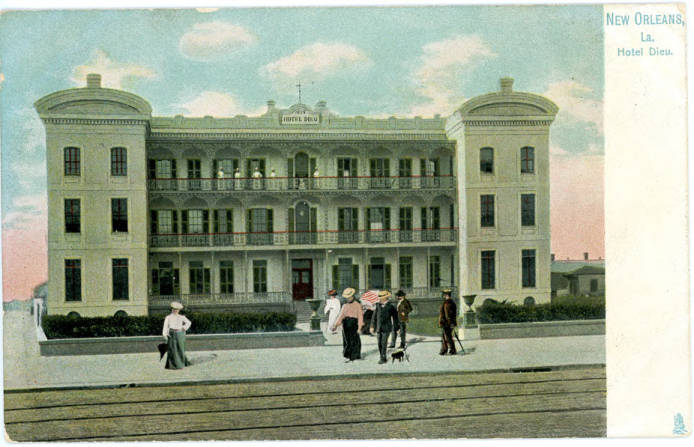
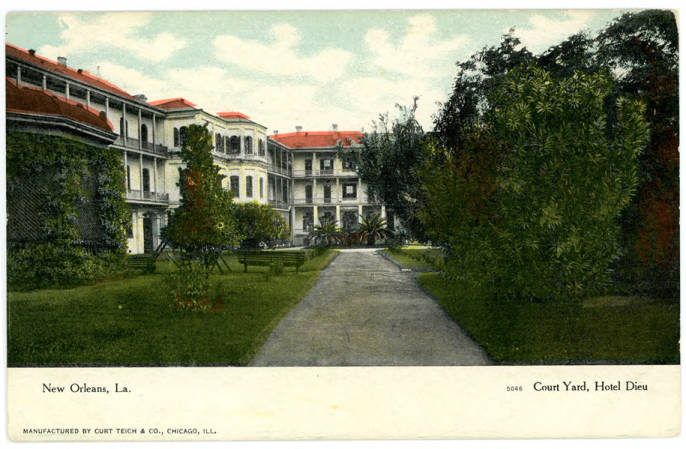
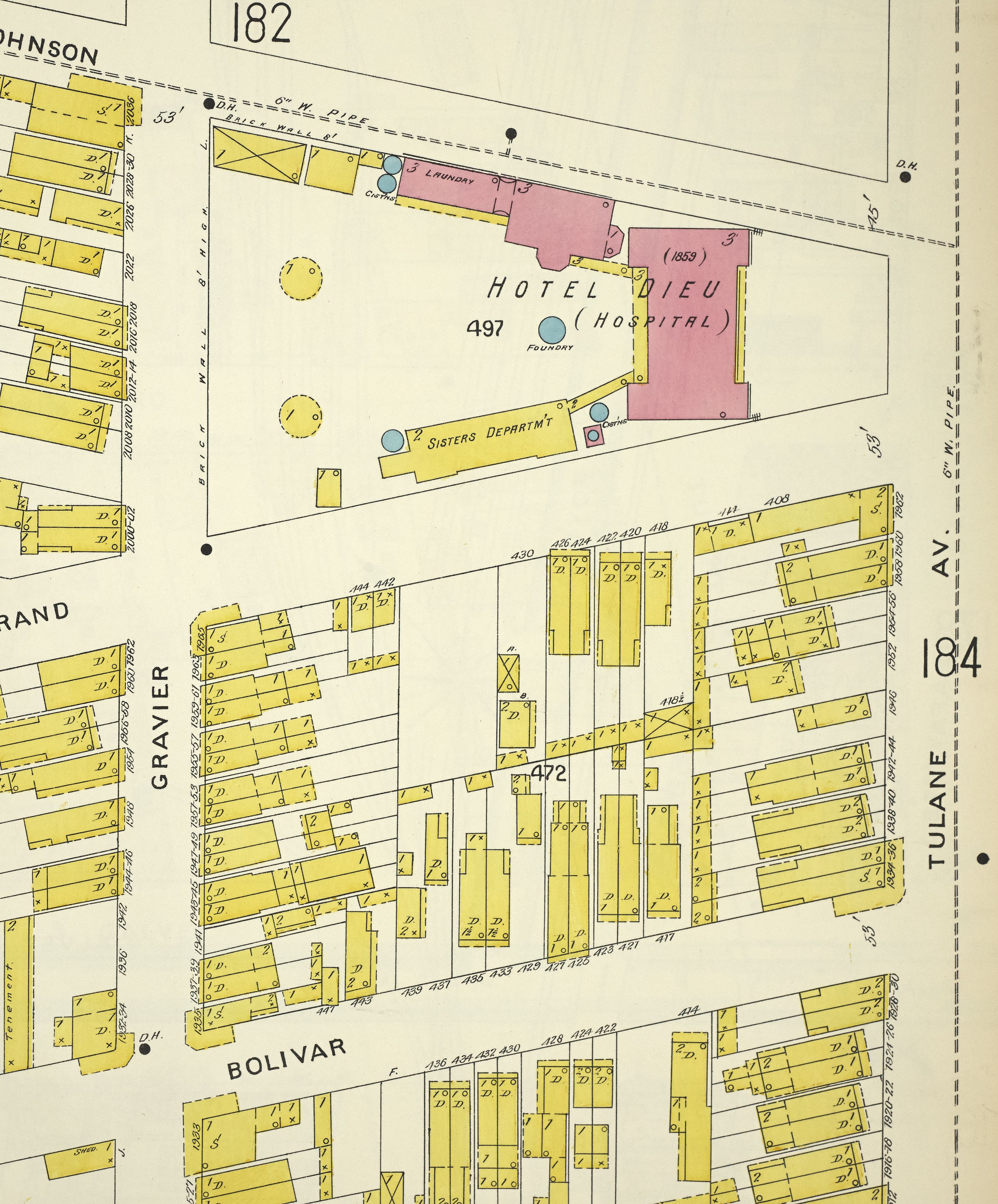
Hotel Dieu (French for “House of God”) hospital opened in New Orleans in 1859, run by the Sisters of Charity of St. Vincent de Paul. It was described as “a most excellent establishment” and its appearance “an ornament to the city” (Times Picayune, July 10, 1859).  Hotel Dieu opened on Common St. with a 100 patient capacity. By 1923, an addition was added, bringing capacity to 260. By the 1970s, an entire new building was added, and eventually the hospital was purchased by LSU and became University Medical, a teaching hospital. University Medical sustained damages from Hurricane Katrina in 2005, yet reopened in 2009 to serve the New Orleans population. Although none of the original Hotel Dieu buildings remain, University Medical Center still operates from its new facility in the same city block.

The Archives holds historic patient registers from Hotel Dieu on microfilm, dating from 1859-1899. This represents the entirety of our records from the hospital.

Researchers can read more about Hotel Dieu in the following publications:

Introducing the New Hotel Dieu Hospital, 1972
Over A Century of Service, The New Hotel Dieu Hospital,
Hotel Dieu

Hotel Dieu

Postcard Collection, undated

Hotel Dieu

Hotel Dieu

Postcard Collection, undated

Robinson Atlas, 1883

Robinson Atlas, 1883

Sanborn Map, 1895

Sanborn Map, 1895

Sanborn Map, 1964

Sanborn Map, 1964

Perhaps the most well known medical complex in New Orleans is Charity Hospital. Shuttered and abandoned since Hurricane Katrina in 2005, Charity Hospital served as the city’s main public hospital for over a century. Charity traces its history back to French colonial times, opening in the French Quarter in the 1730s. Over the next two hundred and fifty years, Charity Hospital occupied multiple locations throughout the city, until finally moving into the massive Tulane Avenue complex in the 1930s. (Check out the City Archives’ look at 1906 Charity Hospital.) After receiving damage from Hurricane Katrina, the hospital never reopened. Redevelopment of the Charity Hospital buildings began in 2026.

The Archives holds historic records from Charity Hospital on microfilm, dating from 1818-1904. This represents the entirety of our records from the hospital.

Charity Hospital
Charity Hospital, ca. 1900; Charles Milo Williams Photo Collection
Mercy Hospital
Mercy Hospital first opened in the 1924 in the Lower Garden District. The hospital moved to its MidCity location in the early 1960s, where it operated until Hurricane Katrina in 2005. By then called the Lindy Boggs Medical Center, the complex has sat empty since. The City began demolition of the medical complex in August 2026.

Created by Brittanny Silva, 2026

Thank you for sharing your photos with us! Please save your photos to Sneauxmageddon Photo Submissions.